Program Notes: Gershwin's An American in Paris
Notes about:
Dawson’s Negro Folk Symphony
Boulanger’s D’un Matin de Printemps
Gershwin’s An American in Paris
Program Notes for February 9 & 10, 2024
Gershwin’s An American in Paris


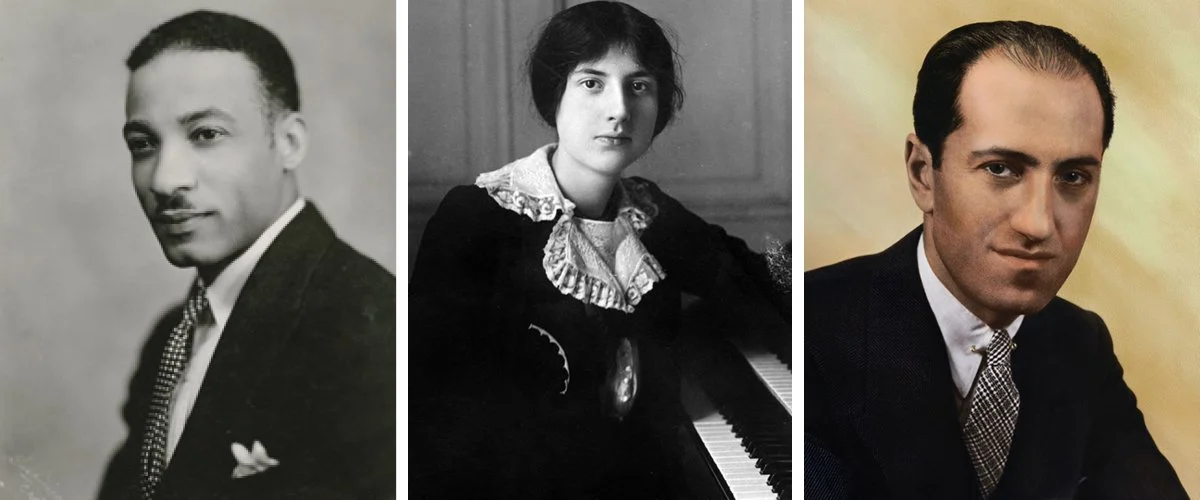
William dawson
Negro Folk Symphony

Composer: born September 26, 1899, Anniston, AL; died May 2, 1990, Montgomery, AL
Work composed: 1934, rev. 1952
World premiere: Leopold Stokowski led the Philadelphia Orchestra on November 20, 1934, at Carnegie Hall in New York City
Instrumentation: piccolo, 2 flutes, 2 oboes, English horn, 3 clarinets, bass clarinet, 2 bassoons, contrabassoon, 4 horns, 3 trumpets, 3 trombones, tuba, timpani, adawura (Ghanaian bell), African clave, bass drum, chimes, cymbals, gong, snare drum, tenor drum, xylophone, harp, and strings
Estimated duration: 30 minutes
“I’ve not tried to imitate Beethoven or Brahms, Franck or Ravel – but to be just myself, a Negro,” William Dawson remarked in a 1932 interview. “To me, the finest compliment that could be paid my symphony when it has its premiere is that it unmistakably is not the work of a white man. I want the audience to say: ‘Only a Negro could have written that.’”
Two years later, Leopold Stokowski led the New York Philharmonic in the premiere of Dawson’s Negro Folk Symphony. Critics and audiences alike hailed it as a masterpiece. One reviewer declared it “the most distinctive and promising American symphonic proclamation which has so far been achieved,” and another enthused, “the immediate success of the symphony [did not] give rise to doubts as to its enduring qualities. One is eager to hear it again and yet again.” Given this overwhelmingly positive reception, Dawson’s Negro Folk Symphony, which at the time he thought of as the first of several future symphonies, should have been heard “again and yet again.” But it was not. Despite Stokowski’s advocacy for Dawson and the Negro Folk Symphony, and despite the stellar reviews it received at its premiere, within a few years both the music and its composer had faded into relative obscurity. Dawson never composed another symphony, although he did continue writing and arranging music – primarily spirituals, which he preferred to call “Negro folk songs” – for the rest of his long career.
In the current climate of racial reckoning, Dawson’s Negro Folk Symphony is enjoying a long-overdue revival, as is the music of other Black classical composers such as Florence Price, William Grant Still, Nathaniel Dett, and many others.
Dawson wrote that his symphony was “symbolic of the link uniting Africa and her rich heritage with her descendants in America,” and gave each of its three movements a descriptive title. Dawson explained in his own program note: “The themes are taken from what are popularly known as Negro Spirituals. In this composition, the composer has employed three themes taken from typical melodies over which he has brooded since childhood, having learned them at his mother’s knee.” Musicologist Gwynne Kuhner Brown observes, “The themes are handled with such virtuosic flexibility of rhythm and timbre that each movement seems to evolve organically,” creating a “persuasive musical bridge between the ‘Negro Folk’ and the ‘Symphony.’”
In “The Bond of Africa,” Dawson opens with a horn solo. The dialogue between the horn and the orchestra echoes the call-and-response format of most spirituals. The horn solo repeats, usually in abbreviated form, several times throughout this movement, and serves as a musical “bond” holding the work together. The central slow movement, “Hope in the Night,” also features a unifying solo. Here an English horn sounds Dawson’s own spiritual-inspired melody, which he described as an “atmosphere of the humdrum life of a people whose bodies were baked by the sun and lashed with the whip for two hundred and fifty years; whose lives were proscribed before they were born.” Underneath the plaintive tune, the orchestra provides a dirge-like accompaniment that builds to an ominous repetition of the solo for tutti orchestra. This episode is offset by an abrupt change of mood, and we hear a lighthearted, up-tempo reworking of the original tune (the “hope” of the movement’s title). These two contrasting interludes alternate throughout the rest of the movement. Towards the end, Dawson reworks the harmony, which has been grounded in minor keys up to this point, and tiptoes towards major tonalities without fully embracing them. Musically, this device works as a powerful metaphor for the importance and elusive nature of hope to sustain people through traumatic circumstances.
The closing section, “Oh, Le’ Me Shine, Shine Like A Morning Star!” imagines a world in which the hopes of the previous movement are fully realized. Dawson creates this musical utopia through rhythm. The central melody showcases accented off-beat exclamations from various solo instruments and sections throughout, as the rhythms layer increasingly complex parts over one another. Dawson revised this movement in the early 1950s after he encountered the intricate polyrhythms of West African music during a trip to Africa. The interlocking parts and the sounds of African percussion instruments captured Dawson’s ear; when he returned to America, he added these elements. Eventually all these rhythmic strands come together in a final buoyant exclamation.
Lili Boulanger
D’un matin de printemps (From A Spring Morning)
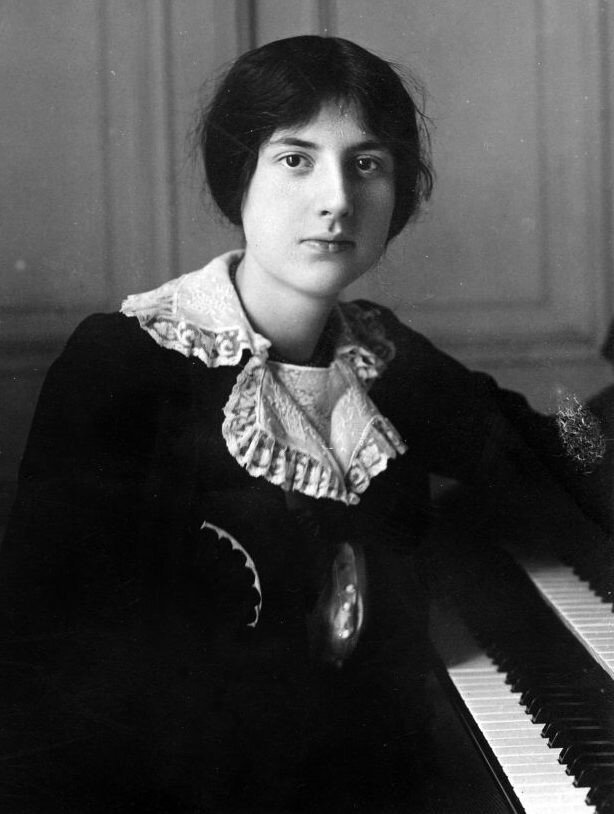
Composer: born August 21, 1893, Paris; died March 15, 1918, Mézy-sur-Seine
Work composed: 1917-18. Boulanger made arrangements in multiple versions: for violin and piano, string trio, and full orchestra
World premiere: undocumented
Instrumentation: piccolo, 2 flutes, 2 oboes, English horn, 2 clarinets, bass clarinet, 2 bassoons, contrabassoon, 4 horns, 2 trumpets, 3 trombones, tuba, bass drum, castanets, cymbals, tambourine, tam-tam, timbales, triangle, celeste, harp, and strings
Estimated duration: 5 minutes
Women composers, like other female creative artists, have to fight battles their male counterparts do not. Even today, a female visual artist, writer, or composer is sometimes evaluated on criteria that have little or nothing to do with her work, and everything to do with her gender, her appearance, or her life circumstances. Lili Boulanger was no exception.
The younger sister of composer and pedagogue Nadia Boulanger, who taught composition to many of the 20th century’s most distinguished composers, Lili Boulanger revealed her enormous talent at a very young age. She was a musical prodigy born into a musical family; in 1913, at age 20, she became the first woman to win the coveted Prix de Rome, France’s most prestigious composition prize. Boulanger’s compositional style, while grounded in the prevailing impressionistic aesthetics associated with Claude Debussy, is nonetheless wholly her own. Her music features rich harmonic colors, hollow chords (open fifths and octaves), ostinato figures, running arpeggios, and static rhythms.
Along with her tremendous musical ability, Boulanger was born with a chronic, debilitating intestinal illness, probably Crohn’s disease. Today there are drugs and other therapies to manage this condition, but in Boulanger’s time the illness itself had neither name nor cure, and its treatment was likewise little understood. Throughout her short life, Boulanger suffered from acute abdominal pain, bouts of uncontrollable diarrhea, and constant fatigue; all these symptoms naturally impacted her stamina and her ability to write. Contemporary reviews of Boulanger’s work always emphasized her physical fragility, often in lieu of a thoughtful assessment of her music.
Despite illness, Boulanger continued composing, even on her deathbed. D’un matin printemps, the second half of a diptych that includes its shorter counterpart D’un soir triste (From a Sad Evening) are two of the last works she wrote. Both pieces treat the same opening melodic and rhythmic theme in different ways: in D’un soir triste, the tempo is slow and the mood elegiac, while the same melodic/rhythmic fragment receives a cheerful, puckish treatment in D’un matin printemps that sparkles with effervescence and youthful joy.
George gershwin
An American in Paris

Composer: born September 26, 1898, Brooklyn, NY; died July 11, 1937, Hollywood, CA
Work composed: March - June 1928, while Gershwin and his siblings were vacationing in Paris
World premiere: Walter Damrosch led the New York Philharmonic on December 13, 1928 in New York
Instrumentation: 3 flutes (1 doubling piccolo), 2 oboes, English horn, 2 clarinets, bass clarinet, 3 saxophones (alto, tenor, baritone), 2 bassoons, 4 horns, 3 trumpets, 3 trombones, tuba, timpani, bass drum, bells, cymbals, snare drum, taxi horns, tom-toms, triangle, xylophone, celesta, and strings
Estimated duration: 17 minutes
“My purpose here is to portray the impression of an American visitor in Paris, as he strolls about the city and listens to various street noises and absorbs the French atmosphere,” wrote George Gershwin about his tone poem, An American in Paris. “As in my other orchestral compositions, I’ve not endeavored to represent any definite scenes in this music. The rhapsody is programmatic only in a general impressionistic way, so that the individual listener can read into the music such as his imagination pictures for him,” This highly evocative, colorful symphonic music expertly captures the sights and sounds of Paris as its American protagonist wanders through the city streets. To illustrate the American’s journey, Gershwin included several of what he termed “walking themes,” which recur throughout the work. The trumpet sounds the most recognizable of these, the “homesick music,” in a bluesy solo. The “American” section concludes with an up-tempo Charleston played by a pair of trumpets, and the walking themes return. Finally, the orchestra winds up with a glittering exuberant finale as night falls on the City of Light.
An American in Paris marked a breakthrough for Gershwin as a composer, as the first symphonic piece for which he created his own orchestrations. When Rhapsody in Blue premiered in 1924, Gershwin was criticized because the Rhapsody’s orchestral version was created by Ferde Grofé. Four years after Rhapsody’s premiere, with An American In Paris, Gershwin demonstrated his growing command of orchestral colors, effectively silencing his detractors.
© Elizabeth Schwartz
NOTE: These program notes are published here by the Modesto Symphony Orchestra for its patrons and other interested readers. Any other use is forbidden without specific permission from the author, who may be contacted at www.classicalmusicprogramnotes.com

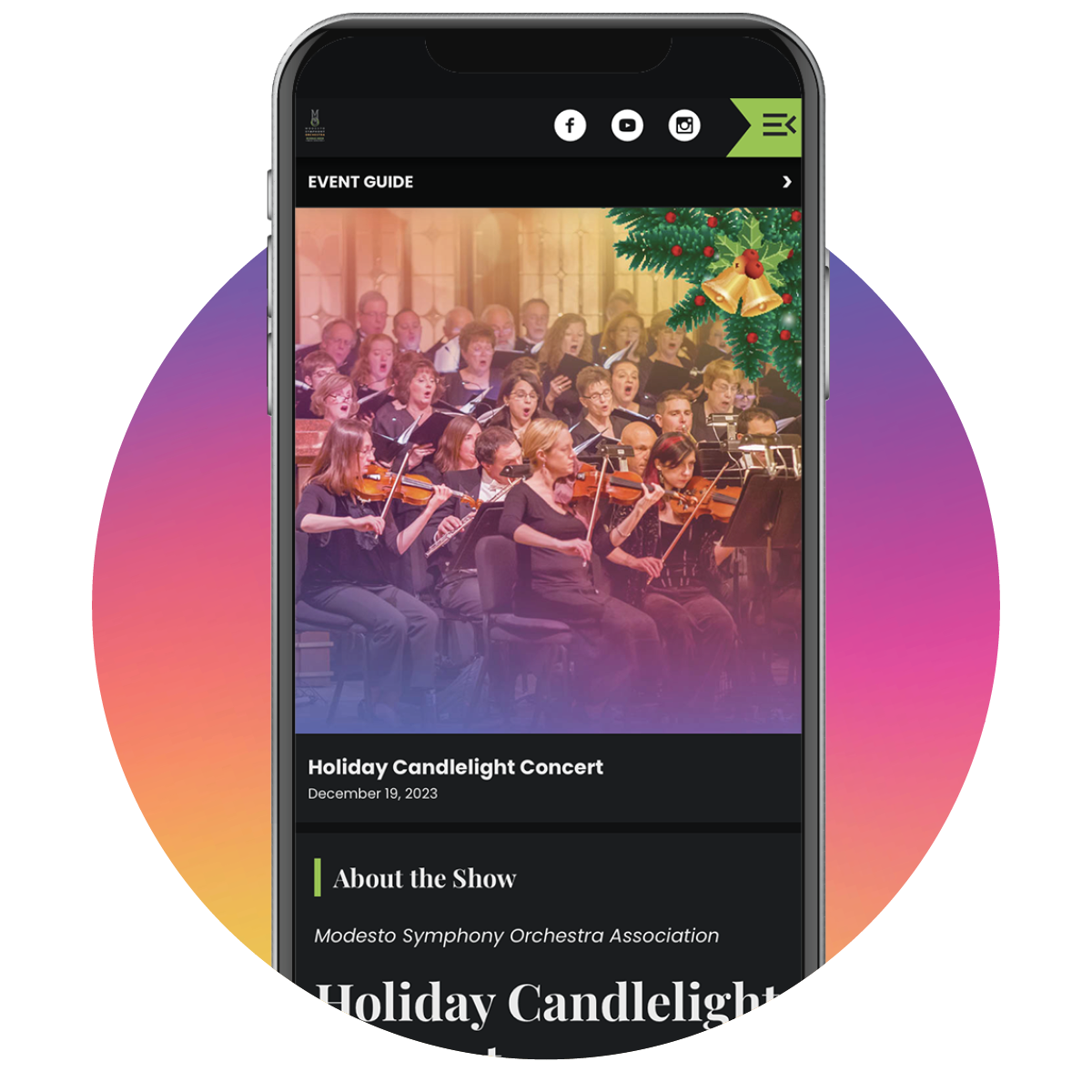
Holiday Candlelight Concert
Tuesday, December 19, 2023 at 8 pm
Modesto Symphony Orchestra
Holiday Candlelight Concert
Tuesday, December 19, 2023
Doors Open at 7 pm
Concert Starts at 8 pm
Our Lady of Fatima Church
505 W. Granger Avenue, Modesto

Program
Camille Saint-Saëns
Prelude (from Oratorio De Noel)
John Rutter
What Sweeter Music
Ludwig Van Beethoven arr. Andrew Duncan
Fanfare on Ode to Joy
- Opus Handbell Ensemble -
arr. Cathy Moklebust
The First Noel
arr. Tom Kennedy
Joy to the World
- Audience Sing-Along -
arr. Steven Pilkington
Coventry Carol
Gustav Holst
Christmas Day
Johann Sebastian Bach arr. Daniel R. Afonso Jr.
Contrapunctus (from Art of the Fugue)
Johann Sebastian Bach
Orchestral Suite No. 2 in B Minor
II. Rondeau
VII. Badinerie
arr. Tom Kennedy
O Little Town of Bethlehem
- Audience Sing-Along -
D. Kantor arr. J. Ferguson
Night of Silence
arr. Joel Raney, Arnold Sherman
An Angelic Celebration
- Opus Handbell Ensemble -
Cathy Moklebust
Vivacio
arr. Tom Kennedy
Silent Night
- Audience Sing-Along -
George Fredrick Handel
Messiah
For Unto Us A Child Is Born
Surely, He Hath Borne Our Griefs
Lift Up Your Heads, Ye Gates
Hallelujah
Join Mobile MSO!
Text “CANDLELIGHT” to (209) 780-0424
to receive a link to the concert program & text message updates prior to this performance!
By texting to this number, you may receive messages that pertain to the Modesto Symphony Orchestra and its performances. msg&data rates may apply. Reply HELP for help, STOP to cancel.
About this Performance


Holiday Pops!
December 1, 2023 at 7:30 pm
December 2, 2023 at 2 pm
Modesto Symphony Orchestra
Holiday Pops!
Friday, December 1, 2023 at 7:30 pm
Saturday, December 3, 2022 at 2 pm
Mary Stuart Rogers Theater, Gallo Center for the Arts

Program
Holiday Overture
Stephenson
O Come All Ye Faithful
arr. Forrest
It’s the Most Wonderful Time of the Year
Kessler
I Wonder as I Wander
Niles / arr. Reineke
Winter Wonderland
Bernard / arr. Berens
The Secret of Christmas
Van Heusen & Cahn / arr. Mann
Charleston Christmas
Stephenson
Holiday Hits Medley
Various Artists / arr. Shoup
Intermission -
Sing We Now of Christmas
arr. Bradford
Sing A Long
arr. Reineke
I’ll Be Home for Christmas
Gannon & Kent / arr. Reineke
Jingle Bell Rock
arr. Stephenson
Christmas, Why Can’t I Find You
Horner / arr. Reineke
Sleigh Ride
Anderson
Jingle, Jingle Bells
Traditional Arrangement / arr. Lai, Shirar
O Holy Night
Clydesdale
Join Mobile MSO!
Text “PROGRAM” to (209) 780-0424
to receive a link to the concert program & text message updates prior to this weekend’s performance!
By texting to this number, you may receive messages that pertain to the Modesto Symphony Orchestra and its performances. msg&data rates may apply. Reply HELP for help, STOP to cancel.
About this Performance

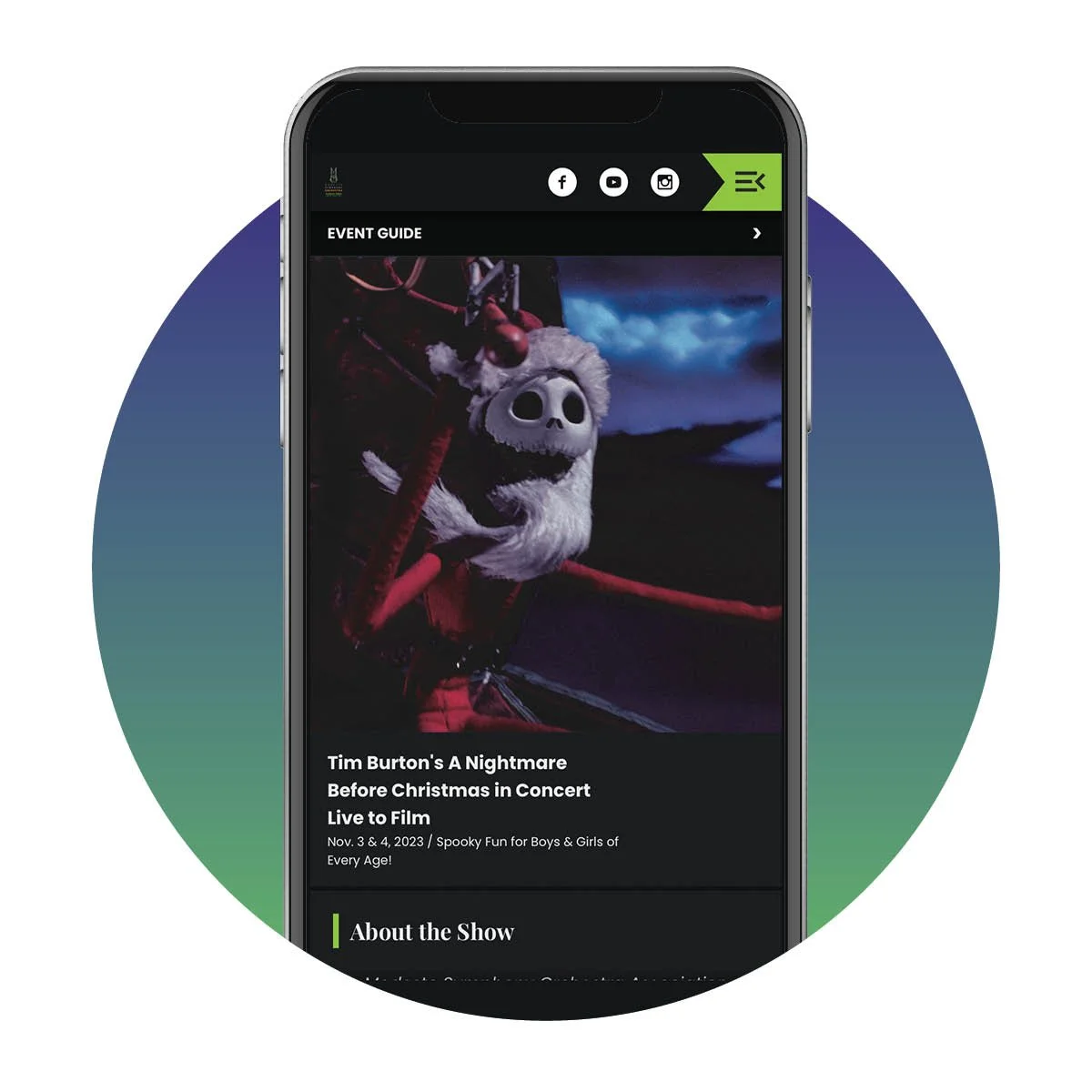
Tim Burton's The Nightmare Before Christmas In Concert Live to Film
November 3, 2023 at 7:30 pm
November 4, 2023 at 2:00 pm
Modesto Symphony Orchestra
Tim Burton’s “The Nightmare Before Christmas” in Concert
Friday, November 3, 2023 at 7:30 pm
Saturday, November 4, 2023 at 2:00 pm
Gallo Center for the Arts, Mary Stuart Rogers Theater

Tim Burton’s “The Nightmare Before Christmas” in Concert
Feature Film with Orchestra
Presentation licensed by Disney Concerts © All rights reserved.
Featuring the voice talents of:
Chris Sarandon
Catherine O’Hara
Ken Page
William Hickey
Glenn Shadix
Paul Reubens
A BURTON/DI NOVI Production
Music, Lyrics & Score by DANNY ELFMAN
Based on a Story and Characters by TIM BURTON
Adaptation by MICHAEL MCDOWELL
Screenplay by CAROLINE THOMPSON
Produced by TIM BURTON and DENISE DI NOVI
Directed by HENRY SELICK
Soundtrack available on WALT DISNEY RECORDS
This film is rated “PG.”
There will be one intermission
Join Mobile MSO!
Text “PROGRAM” to (209) 780-0424
to receive a link to the concert program & text message updates prior to this performance!
By texting to this number, you may receive messages that pertain to the Modesto Symphony Orchestra and its performances. msg&data rates may apply. Reply HELP for help, STOP to cancel.
About this Performance


Tchaikovsky & Copland
October 13 & 14, 2023 at 7:30 pm
VISIT MOBILE PROGRAM →
READ OUR PROGRAM NOTES →
DOWNLOAD PRINTABLE VERSION (pdf, 3mb) →
Modesto Symphony Orchestra
Tchaikovsky & Copland
Friday, October 13, 2023 at 7:30 pm
Saturday, October 14, 2023 at 7:30 pm
Gallo Center for the Arts, Mary Stuart Rogers Theater
Nicholas Hersh, conductor
Alessio Bax, piano

Program
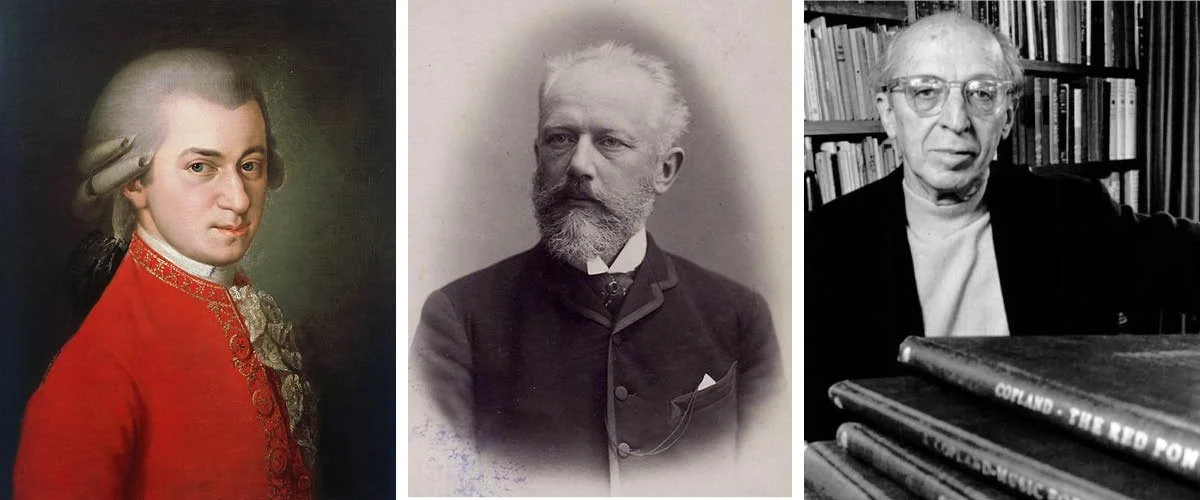
Wolfgang Amadeus Mozart (1756-1791)
Overture to The Marriage of Figaro KV492 (1786)
Pyotr Ilyich Tchaikovsky (1840-1893)
Piano Concerto No. 1 in B-flat minor, Op. 23 (1875)
Alessio Bax, piano
i.Allegro
ii.Andantino
iii.Allegro
- INTERMISSION -
Aaron Copland (1900-1990)
Symphony No. 3 (1946)
i.Molto moderato
ii.Allegro molto
iii.Andantino quasi allegretto
iv.Molto deliberato
Join Mobile MSO!
Text “PROGRAM” to (209) 780-0424
to receive a link to the concert program & text message updates prior to this performance!
By texting to this number, you may receive messages that pertain to the Modesto Symphony Orchestra and its performances. msg&data rates may apply. Reply HELP for help, STOP to cancel.
About this Performance

Program Notes: Tchaikovsky & Copland
Notes about:
Mozart’s Overture to The Marriage of Figaro KV492
Tchaikovsky’s Piano Concerto No.1 in B-flat minor, Op. 23
Copland’s Symphony No. 3
Program Notes for october 13 & 14, 2023
Tchaikovsky & Copland

Wolfgang Amadeus Mozart
Overture from Le nozze di Figaro, K. 492

Composer: born January 27, 1756, Salzburg, Austria; died December 5, 1791, Vienna
Work composed: May 28, 1786.
World premiere: Mozart conducted the first performance of Figaro at Vienna’s Burgtheater on May 1, 1786
Instrumentation: 2 flutes, 2 oboes, 2 clarinets, 2 bassoons, 2 horns, 2 trumpets, timpani, and strings
Estimated duration: 4 minutes
The best way to generate interest in something is to ban it. This holds as true today as it did in 1782, when King Louis XIV, after attending a private reading of a French comedy of manners written by Pierre Beaumarchais, declared it “detestable.” Beaumarchais’ play contained revolutionary ideas too dangerous for commoners to hear, as far as the rulers of Europe was concerned. Austria’s Emperor Joseph II agreed, and banned Beaumarchais’ play within Austria’s borders.
When Wolfgang Amadeus Mozart encountered Beaumarchais’ subversive play, he saw in it the perfect basis for an opera. With librettist Lorenzo da Ponte, Mozart relocated the story of Figaro, Susanna, Count Almaviva and Countess Rosina, and all their circle to Italy, and toned down the more obvious revolutionary elements.
The dizzyingly intricate plot of Le nozze di Figaro, Mozart’s most popular and frequently staged opera, is rife with twists, turns, reversals, misunderstandings, rumors, gossip, and deceptions. Such narrative complexity is mirrored in the Overture’s series of running notes, which generate the nonstop high energy needed to keep the story going over four acts. As was common at the time, none of the actual music in the opera appears in the Overture, but the anticipatory excitement of the music readies the audience for all the shenanigans to come.
Piotr ilyich tchaikovsky
Piano Concerto No.1 in B-flat minor, Op. 23

Composer: born May 7, 1840, Kamsko-Votinsk, Vitaka province, Russia; died November 6, 1893, St. Petersburg
Work composed: Tchaikovsky began composing his first piano concerto in November 1874 and finished it in February, 1875. He revised it in the summer of 1879 and again in December 1888; this final revision is the one usually performed. Tchaikovsky originally dedicated the concerto to his mentor Nicolai Rubinstein, but after Rubinstein declared it unplayable, Tchaikovsky removed his mentor’s name from the manuscript and dedicated it to pianist and conductor Hans von Bülow.
World premiere: Valter Poole led the Michigan WPA Symphony Orchestra (aka the Detroit Civic Symphony) on November 6, 1940
Instrumentation: solo piano, 2 flutes, 2 oboes, 2 clarinets, 2 bassoons, 4 horns, 2 trumpets, 3 trombones, timpani, and strings.
Estimated duration: 33 minutes
The first measures of Piotr Ilyich Tchaikovsky’s Piano Concerto No. 1 have assumed an identity all their own. Many people recognize the four-note descending horn theme and the iconic crashing chords of the pianist’s first entrance without knowing the work as a whole. Interestingly, this signature introduction to the Piano Concerto No. 1 is just that, an introduction; after approximately 100 measures it disappears and never returns. These opening bars have also become part of popular culture, as the theme to Orson Welles’ Mercury Theatre radio programs; in the 1971 cult film Harold and Maude; and in a Monty Python sketch.
Although the rest of the concerto is equally compelling, that was not the initial opinion of Tchaikovsky’s friend and mentor, Nikolai Rubinstein. Rubinstein, director of the Moscow Conservatory, had premiered many of Tchaikovsky’s works, including Romeo and Juliet. Tchaikovsky considered Rubinstein “the greatest pianist in Moscow,” and wanted Rubinstein’s help regarding the technical aspects of the solo piano part. In a letter to his patron Nadezhda von Meck, Tchaikovsky described his now-infamous meeting with Rubinstein on Christmas Eve, 1874: “I played the first movement. Not a single word, not a single comment!” After Tchaikovsky finished, as he explained to Mme. von Meck, “A torrent poured from Nikolai Gregorievich’s mouth … My concerto, it turned out, was worthless and unplayable – passages so fragmented, so clumsy, so badly written as to be beyond rescue – the music itself was bad, vulgar – only two or three pages were worth preserving – the rest must be thrown out or completely rewritten.”
It is true that this concerto is awkwardly constructed in places, with some abrupt musical transitions. The writing for the soloist is often exceedingly difficult, because Tchaikovsky was not a pianist and did not possess a player’s kinetic, idiomatic knowledge. However, Rubinstein’s excessively negative reaction seems disproportionate.
After the majestic introduction, which anticipates the harmonic language of the following movements, the Andante non troppo continues with a theme Tchaikovsky borrowed from a Ukrainian folk song. Woodwinds introduce a second theme, gentler and quieter, later echoed by the piano. The movement ends with a huge cadenza featuring a display of virtuoso solo fireworks.
In the Andantino semplice, Tchaikovsky also features a borrowed melody, “Il faut s'amuser, danser et rire” (You must enjoy yourself by dancing and laughing) from the French cabaret. Tchaikovsky likely meant this tune as a wistful tribute to the soprano Désirée Artôt, with whom he had been in love a few years previously. (In another musical compliment, Tchaikovsky used the letters of her name as the opening notes of a melody from the first movement).
The galloping melody of the Allegro con fuoco, another Ukrainian folk song, suggests a troika of horses racing over the steppes. A rhapsodic theme in the strings recalls the lush texture of the introduction. The two melodies alternate and overlap, dancing toward a monumental coda.
Aaron Copland
Symphony No. 3

Composer: born November 14, 1900, Brooklyn, NY; died December 2, 1990, North Tarrytown, NY
Work composed: 1944-46. Copland’s Third Symphony was commissioned by the Koussevitzky Foundation and Copland dedicated it “to the memory of my good friend, Natalie Koussevitzky.”
World premiere: Serge Koussevitzky led the Boston Symphony Orchestra on October 18, 1946.
Instrumentation: piccolo, 3 flutes (one doubling 2nd piccolo), 3 oboes (one doubling English horn), 2 clarinets, E-flat clarinet, bass clarinet, 2 bassoons, contrabassoon, 4 horns, 4 trumpets, 3 trombones, tuba, timpani, anvil, bass drum, chimes, claves, cymbals, glockenspiel, ratchet, slapstick, snare drum, suspended cymbal, tam tam, tenor drum, triangle, wood block, xylophone, celeste, piano, 2 harps, and strings.
Estimated duration: 38 minutes
In 1922, Nadia Boulanger, who taught composition to many of the 20th century’s greatest composers, introduced conductor Serge Koussevitzky to one of her young American students. From that moment, Koussevitzky and Aaron Copland forged a reciprocal collaboration that lasted until Koussevitzky’s death, in 1951. Koussevitzky championed Copland’s music and taught him the nuances of conducting; in turn, Copland encouraged Koussevitzky to focus on American composers, particularly at the Berkshire Music Center (now the Tanglewood Music center), which Koussevitzky established in 1940 in Lenox, MA.
In 1944, Copland received his last commission from Koussevitzky’s Foundation; this evolved into his most substantial orchestral work, the Third Symphony. Copland explained, “I knew exactly the kind of music he [Koussevitzky] enjoyed conducting and the sentiments he brought to it, and I knew the sound of his orchestra, so I had every reason to do my darndest to write a symphony in the grand manner.”
In his autobiography, Copland wrote, “If I forced myself, I could invent an ideological basis for the Third Symphony. But if I did, I’d be bluffing – or at any rate, adding something ex post facto, something that might or might not be true but that played no role at the moment of creation.” Nonetheless, one cannot help hearing Copland’s Third Symphony as the expression of a country emerging victorious from a devastating war. Copland acknowledged as much, noting that the Third Symphony “intended to reflect the euphoric spirit of the country at the time.”
Copland described the Molto moderato as “open and expansive.” Of particular note is the second theme, a singing melody for violas and oboes, which sounds like an inspirational moment from a film score.
The Andantino quasi allegretto contains the most abstract and introspective music in the symphony. High strings wander through an empty landscape, like soldiers stumbling upon a field after a bloody battle. A solo flute intones a melody that binds the rest of the movement together with, as Copland explains, “quiet singing nostalgia, then faster and heavier – almost dance-like; then more childlike and naïve, and finally more vigorous and forthright.” As the third movement’s various themes weave and coalesce, sounding much like sections of Copland’s ballet music, they produce a half-conscious sense of déjà vu – have we heard this before? Not quite, but almost, and as the third movement dissolves without pause into the final movement, we hear the woodwinds repeating a theme present in all three of the preceding sections. Now the theme shifts, the last jigsaw puzzle piece locks into place, and the Fanfare for the Common Man emerges.
Although the Fanfare is instantly recognizable today, at the time Copland was writing the Third Symphony it was little known. In 1942, Eugene Goossens, music director of the Cincinnati Symphony, commissioned Copland and eighteen other composers to write short, patriotic fanfares, for the orchestra to premiere during their 1942-43 season. Copland explained his choice of title: “It was the common man, after all, who was doing all the dirty work in the war and the army. He deserved a fanfare.”
Copland wanted a heroic finale to represent the Allied victory in WWII, and the Fanfare epitomized it. The flutes and clarinets introduce the basic theme, before the brasses and percussion burst forth with the version most familiar to audiences.
Reviews were enthusiastic, ranging from Koussevitzky’s categorical statement that it was the finest American symphony ever written to Leonard Bernstein’s declaration, “The Symphony has become an American monument, like the Washington Monument or the Lincoln Memorial.”
© Elizabeth Schwartz
NOTE: These program notes are published here by the Modesto Symphony Orchestra for its patrons and other interested readers. Any other use is forbidden without specific permission from the author, who may be contacted at www.classicalmusicprogramnotes.com
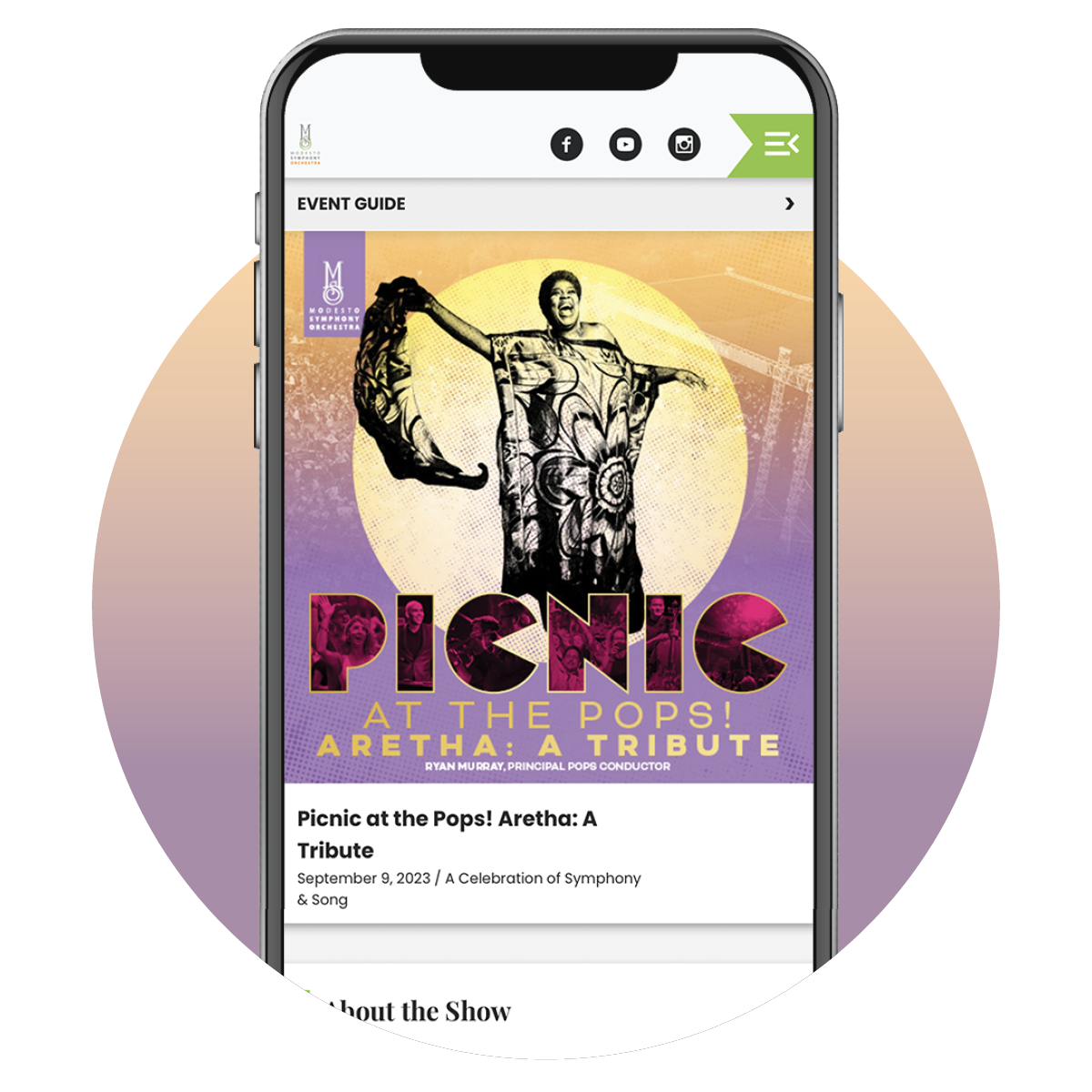
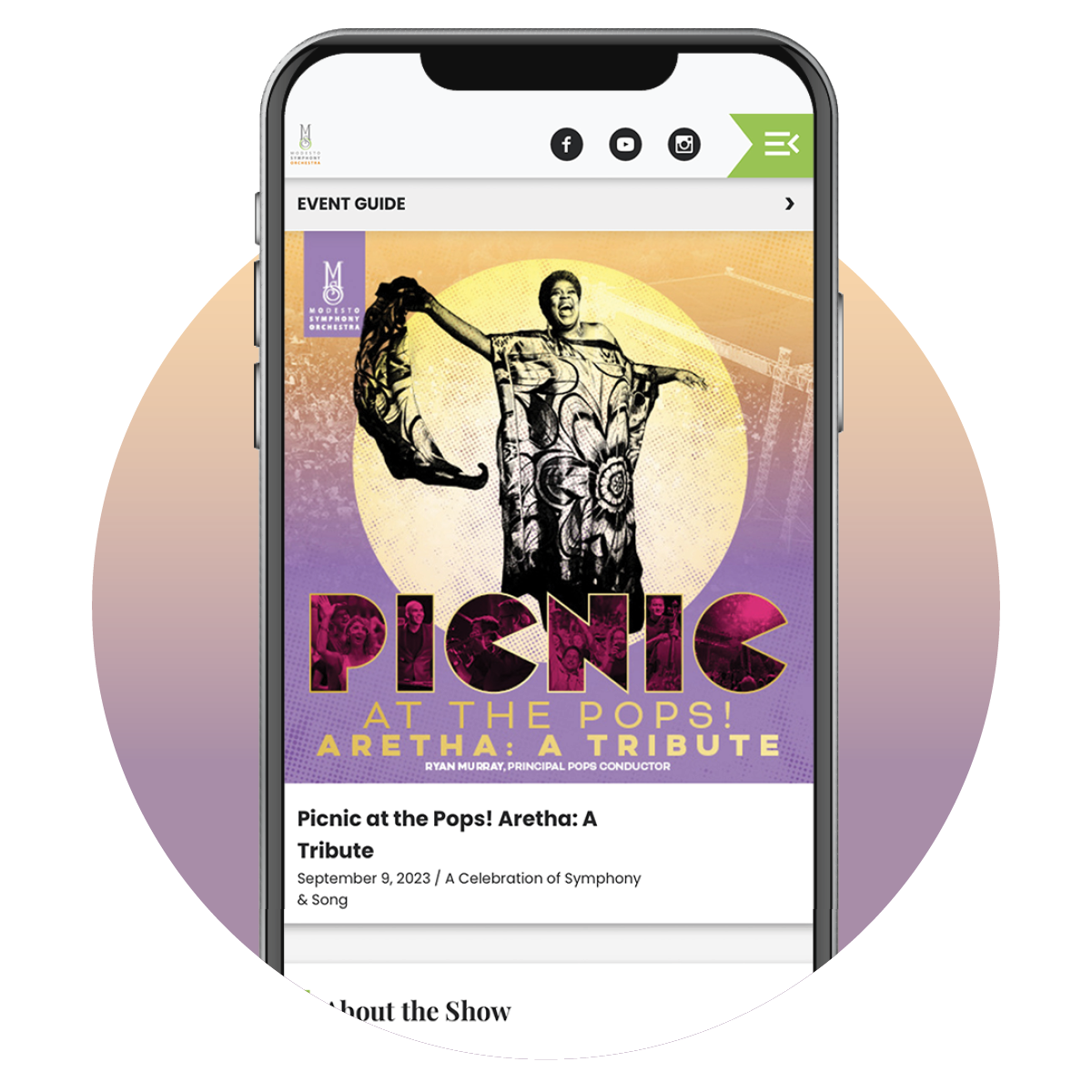
Picnic at the Pops! Aretha: A Tribute
September 9, 2023
Modesto Symphony Orchestra
Picnic at the Pops! Aretha: A Tribute
Saturday, September 9, 2023
Grounds Open: 5:00 pm
Concert Starts: 7:30 pm
E. & J. Gallo Winery Grounds
Program
All selections will be announced from the stage.
There will be one intermission.
About this Performance

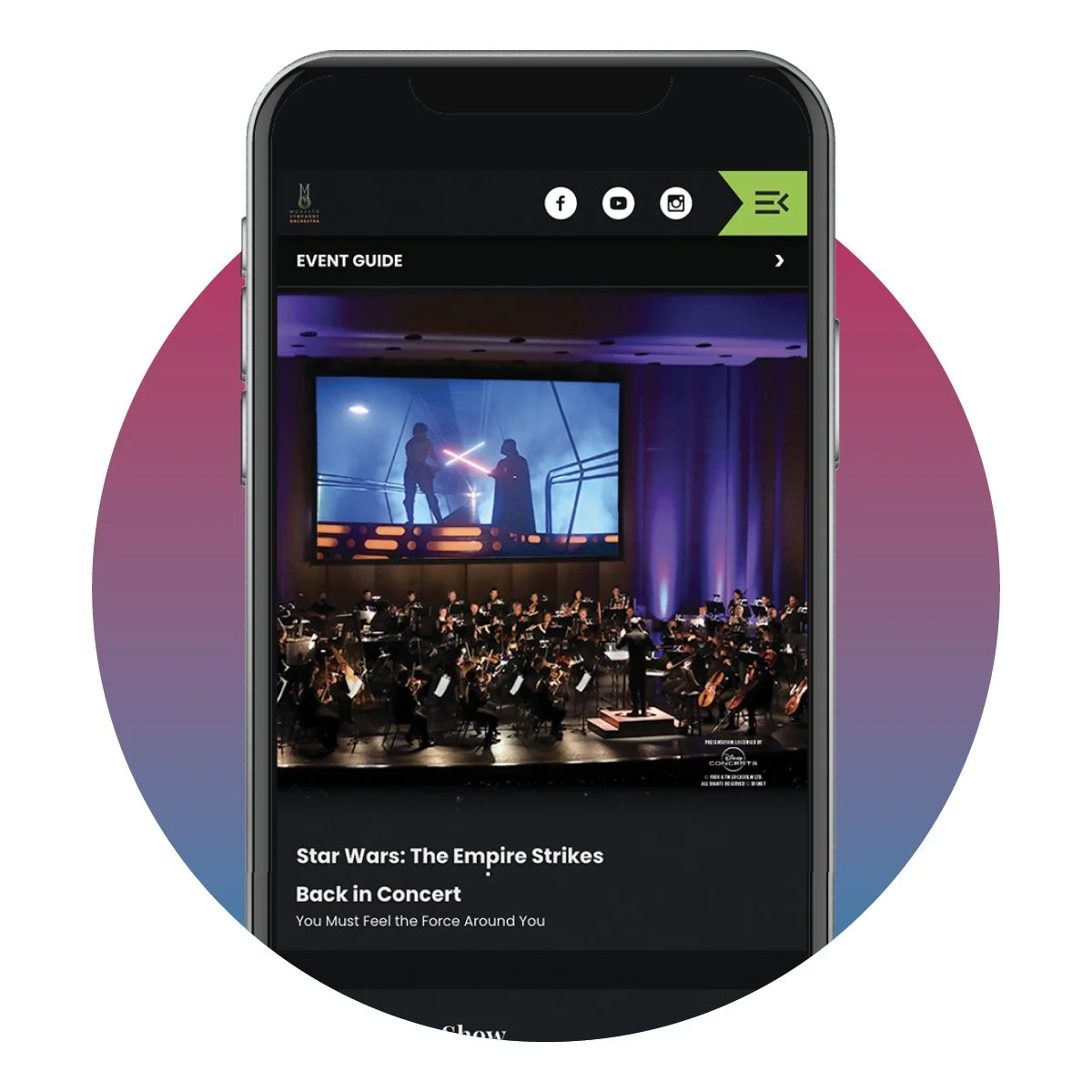
Star Wars: The Empire Strikes Back in Concert
June 2, 2023 at 7:30 pm
June 3, 2023 at 2:00 pm
Modesto Symphony Orchestra
Star Wars: The Empire Strikes Back in Concert
Friday, June 2, 2023 at 7:30 pm
Saturday, June 3, 2023 at 2:00 pm
Gallo Center for the Arts, Mary Stuart Rogers Theater

John Williams (b. 1932)
Star Wars: The Empire Strikes Back in Concert
Feature Film with Orchestra
There will be one intermission.
Presentation licensed by Disney Concerts in association with 20th Century Fox, Lucasfilm Ltd., and Warner/Chappell Music. All rights reserved.
Star Wars Film Concert Series
Star Wars: The Empire Strikes Back
Twentieth Century Fox Presents
A Lucasfilm Ltd. production
Starring
Mark Hamill
Harrison Ford
Carrie Fisher
Billy Dee Williams
Anthony Daniels
Co-Starring
David Prowse as Darth Vader
Kenny Baker as R2-D2
Peter Mayhew as Chewbacca
Frank Oz as Yoda
Directed By
Irvin Kershner
Produced By
Gary Kurtz
Screenplay by
Leigh Brackett and Lawrence Kasdan
Story by
George Lucas
Executive Producer
George Lucas
Music by
John Williams

Original Motion Picture Soundtrack available at Disneymusicemporium.com
Join Mobile MSO!
Text “EMPIRE” to (209) 780-0424
to receive a link to the concert program & text message updates prior to this performance!
By texting to this number, you may receive messages that pertain to the Modesto Symphony Orchestra and its performances. msg&data rates may apply. Reply HELP for help, STOP to cancel.
About this Performance


Mozart Requiem Texts & Translations
Mozart Requiem Texts and Translations
Introit
1. Requiem aeternam 1. Requiem aeternam
Requiem aeternam dona eis, Domine, Grant them eternal rest, O Lord
et lux perpetua luceat eis. and let perpetual light shine on them.
Te decet hymnus, Deus, in Sion, You are praised, God, in Zion,
et tibi reddetur votum in Jerusalem. and homage will be paid to You in Jerusalem.
Exaudi orationem meam, Hear my prayer,
ad te omnis care veniet. to You all flesh will come.
Requiem aeternam dona eis, Domine, Grant them eternal rest, Lord,
et lux perpetua luceat eis. and let perpetual light shine on them.
2. Kyrie 2. Kyrie
Kyrie, eleison. Lord, have mercy on us.
Christe, eleison. Christ, have mercy on us.
Kyrie, eleison. Lord, have mercy on us.
Sequence
3. Dies irae 3. Dies irae
Dies irae, dies illa Day of wrath, day of anger
solvet saeclum in favilla, will dissolve the world in ashes,
teste David cum Sibylla. as foretold by David and the Sibyl.
Quantus tremor est futurus, Great trembling there will be
quando judex est venturus, when the Judge descends from heaven
cuncta stricte discussurus! to examine all things closely.
4. Tuba mirum 4. Tuba mirum
Tuba mirum spargens sonum The trumpet will send its wondrous sound
per sepulcra regionum, throughout earth’s sepulchres
coget omnes ante thronum. and gather all before the throne.
Mors stupebit et natura, Death and nature will be astounded,
cum resurget creatura, when all creation rises again,
judicanti responsura. to answer the judgement.
Liber scriptus proferetur, A book will be brought forth,
in quo totum continetur, in which all will be written,
unde mundus judicetur. by which the world will be judged.
Judex ergo cum sedebit, When the judge takes his place,
quidquid latet, apparebit, what is hidden will be revealed,
nil inultum remanebit. nothing will remain unavenged.
Quid sum miser tunc dicturus? What shall a wretch like me say?
quem patronum rogaturus, Who shall intercede for me,
cum vix justus sit securus? when the just ones need mercy?
5. Rex tremendae 5. Rex tremendae
Rex tremendae majestatis, King of tremendous majesty,
qui salvandos savas gratis, who freely saves those worthy ones,
salve me, fons pietatis. save me, source of mercy.
6. Recordare 6. Recordare
Recordare, Jesu pie, Remember, kind Jesus,
quod sum causa tuae viae; my salvation caused your suffering;
ne me perdas illa die. do not forsake me on that day.
Quaerens me, sedisti lassus, Faint and weary you have sought me,
redemisti crucem passus; redeemed me, suffering on the cross;
tantus labor non sit cassus. may such great effort not be in vain.
Juste judex ultionis, Righteous judge of vengeance,
donum fac remissionis grant me the gift of absolution
ante diem rationis. before the day of retribution.
Ingemisco, tamquam reus: I moan as one who is guilty:
culpa rubet vultus meus; owning my shame with a red face;
supplicanti parce, Deus. suppliant before you, Lord.
Qui Mariam absolvisti, You, who absolved Mary,
et latronem exaudisti, and listened to the thief,
mihi quoque spem dedisti. give me hope also.
Preces meae non sunt dignae, My prayers are unworthy,
sed tu, bonus, fac benigne, but, good Lord, have mercy,
ne perenni cremer igne. and rescue me from eternal fire.
Inter oves locum praesta, Provide me a place among the sheep,
Et ab haedis me sequestra, and separate me from the goats,
Statuens in parte dextra. guiding me to Your right hand.
7. Confutatis 7. Confutatis
Confutatis maledictis, When the accused are confounded,
flammis acribus addictis, and doomed to flames of woe,
voca me cum benedictus. call me among the blessed.
Oro supplex et acclinis, I kneel with submissive heart,
cor contritum quasi cinis, my contrition is like ashes,
gere curam mei finis. help me in my final condition.
8. Lacrimosa 8. Lacrimosa
Lacrimosa dies illa, That day of tears and mourning,
qua resurget ex favilla when from the ashes shall arise,
judicandus homo reus. all humanity to be judged.
Huic ergo parce, Deus, Spare us by your mercy, Lord,
pie Jesu Domine, gentle Lord Jesus,
dona eis requiem. Amen. grant them eternal rest. Amen.
Offertory
9. Domine Jesu 9. Domine Jesu
Domine Jesu Christe, Rex gloriae, Lord Jesus Christ, King of glory,
libera animas omnium fidelium liberate the souls of the faithful,
defunctorum de poenis inferni departed from the pains of hell
et de profundo lacu. and from the bottomless pit.
Libera eas de ore leonis, Deliver them from the lion's mouth,
ne absorbeat eas tartarus, lest hell swallow them up,
ne cadant in obscurum. lest they fall into darkness.
Sed signifer sanctus Michael Let the standard-bearer, holy Michael,
repraesentet eas in lucem sanctam. bring them into holy light.
Quam olim Abrahae promisisti Which was promised to Abraham
et semini ejus. and his descendants.
10. Hostias 10. Hostias
Hostias et preces tibi, Domine, Sacrifices and prayers of praise, Lord,
laudis offerimus. we offer to You.
Tu sucipe pro animabus illis, Receive them in behalf of those souls
quaram hodie memoriam facimus. we commemorate today.
Fac eas, Domine, And let them, Lord,
de morte transire ad vitam, pass from death to life,
Quam olim Abrahae promisisti which was promised to Abraham
et semini ejus. and his descendants.
11. Sanctus 11. Sanctus
Sanctus, sanctus, sanctus Holy, Holy, Holy,
Dominus Deus Sabaoth. Lord God of Hosts.
Pleni sunt caeli et terra gloria tua. Heaven and earth are full of they glory.
Hosanna in excelsis. Hosanna in the highest.
12. Benedictus 12. Benedictus
Benedictus qui venit Blessed is he who comes
in nomine Domini. in the name of the Lord.
Hosanna in excelsis. Hosanna in the highest.
Agnus Dei
13. Agnus Dei 13. Agnus Dei
Agnus Dei, qui tollis Lamb of God, who takes away
peccata mundi, the sins of the world,
dona eis requiem. grant them eternal rest.
Agnus Dei, qui tollis Lamb of God, who takes away
peccata mundi, the sins of the world,
dona eis requiem. Grant them eternal rest.
Agnus Dei, qui tollis Lamb of God, who takes away
peccata mundi, the sins of the world,
dona eis requiem sempiternam. grant them eternal rest forever.
Communion
14. Lux aeterna
Lux aeterna luceat eis, Domine, Let eternal light shine on them, Lord,
cum sanctis tuis in aeternum, as with Your saints in eternity,
quia pius es. because You are merciful.
Requiem aeternum dona eis, Domine, Grant them eternal rest, Lord,
et Lux perpetua luceat eis, and let perpetual light shine on them,
cum Sanctus tuis in aeternum, as with Your saints in eternity,
quia pius es. because You are merciful.
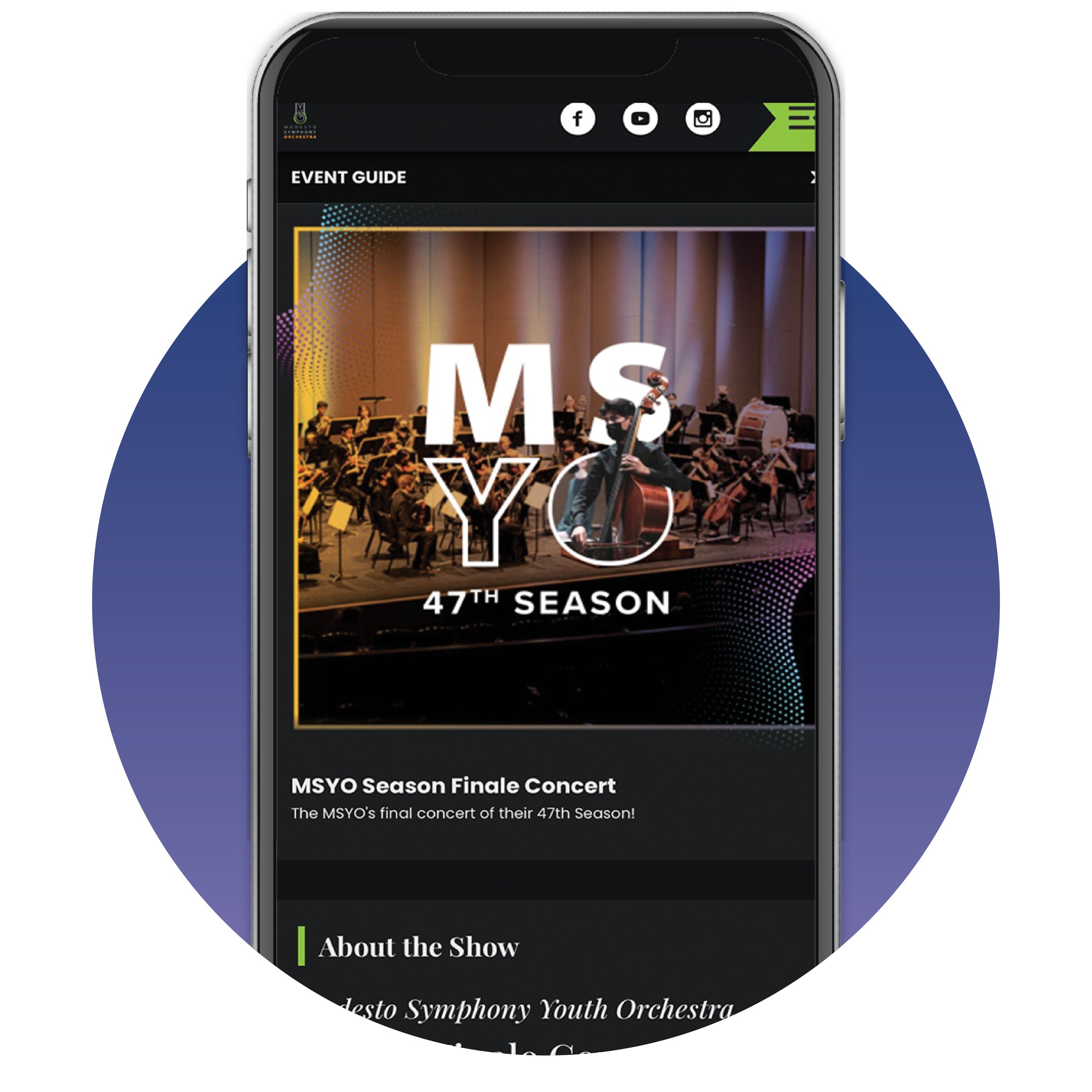
MSYO Season Finale Concert
May 13, 2023 at 2 pm
Modesto Symphony Youth Orchestra
Season Finale Concert
Saturday, May 13, 2023, 2:00pm
Gallo Center for the Arts, Mary Stuart Rogers Theater

Program
Concert Orchestra
Donald C. Grishaw, conductor
Johann Sebastian Bach (1685-1750)
Jesu, Joy of Man's Desiring arr. Merle Isaac
Mikhail Ippolitov-Ivanov (1859-1935)
Procession of the Sardar from Caucasian Sketches arr. Merle Isaac
Jose Padilla (1889-1960)
El Relicario arr. Merle Isaac
Woodwind Quintet
Edvard Grieg (1843-1907)
In the Hall of the Mountain King
Brass Ensemble
Klaus Badelt (b. 1967)
Pirates of the Caribbean arr. John Wasson
Percussion Ensemble
Chris Brooks (b. 1957)
Mambo Schmambo
Intermission
Honoring Seniors
Symphony Orchestra
Wayland Whitney, conductor
Gerónimo Giménez (1854-1923)
Intermedio from La Boda de Luís Alonso
Ernesto Lecuona (1895-1923)
Andalucia Suite arr. Gordon Jenkins
Jules Massenet (1842-1912)
Selections from Le Cid Suite
III. Aragonaise
VII. Navarraise
Join Mobile MSO!
Text “MSYO” to (209) 780-0424
to receive a link to the concert program & text message updates prior to this performance!
By texting to this number, you may receive messages that pertain to the Modesto Symphony Orchestra and its performances. msg&data rates may apply. Reply HELP for help, STOP to cancel.
About this Performance

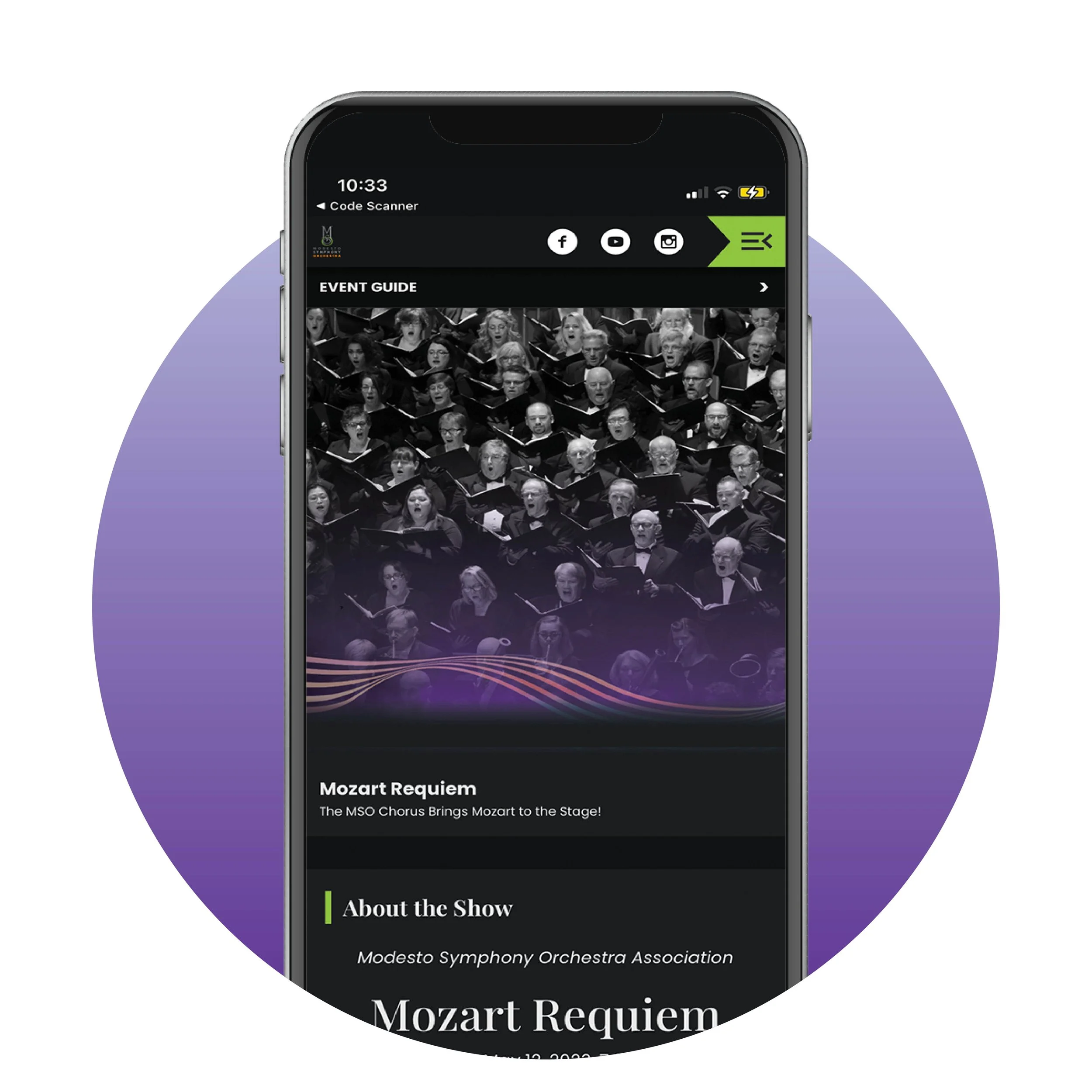
Mozart Requiem
February 10 & 11, 2023 at 7:30 pm
VISIT MOBILE PROGRAM →
READ OUR PROGRAM NOTES →
DOWNLOAD PRINTABLE VERSION (pdf, 3mb) →
Modesto Symphony Orchestra
Mozart Requiem
Friday, May 12, 2023 at 7:30 pm
Saturday, May 13, 2023 at 7:30 pm
Gallo Center for the Arts, Mary Stuart Rogers Theater
Anthony Parnther, conductor
MSO Chorus
Daniel R. Afonso Jr. , chorus director
Jennifer Lindsay, soprano
Maria Dominique Lopez, mezzo-soprano
Orson Van Gay, II, tenor
Zachary Gordin, baritone

Program
Wolfgang Amadeus Mozart (1756-1791)
Requiem, K. 626 (1791)
MSO Chorus
Daniel R. Afonso Jr., chorus director
Jennifer Lindsay, soprano
Maria Dominique Lopez, mezzo soprano
Orson Van Gay II, tenor
Zachary Gordin, baritone
- INTERMISSION -
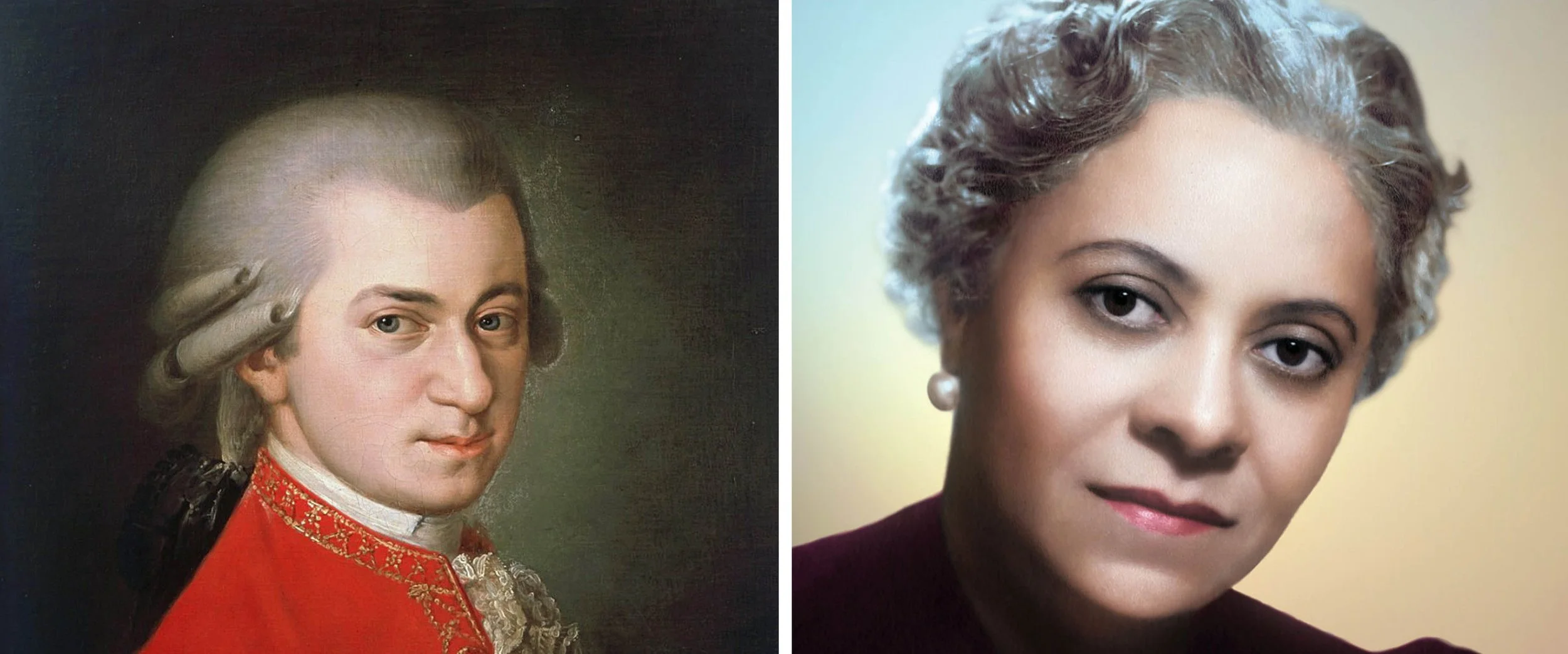
Florence Price (1887-1953)
Symphony No. 3 in C minor (1938)
Andante
Andante ma non troppo
Juba: Allegro
Scherzo: Finale
Join Mobile MSO!
Text “PROGRAM” to (209) 780-0424
to receive a link to the concert program & text message updates prior to this performance!
By texting to this number, you may receive messages that pertain to the Modesto Symphony Orchestra and its performances. msg&data rates may apply. Reply HELP for help, STOP to cancel.
About this Performance
Program Notes: Mozart Requiem
Notes about:
Mozart’s Requiem, K. 626
Price’s Symphony No. 3 in C minor
Program Notes for MAy 12 & 13, 2023
Mozart Requiem
Wolfgang Amadeus Mozart
Requiem, K. 626 (completed by Robert Levin)
Composer: born January 27, 1756, Salzburg, Austria; died December 5, 1791, Vienna
Work composed: 1791. Mozart died before completing the Requiem, an anonymous commission from Count Franz Walsegg von Stuppach. The Requiem was originally finished by one of Mozart’s students, Franz Xaver Süssmayr. The version heard in these concerts was realized and completed by musicologist Robert Levin in 1991.
World premiere: Helmuth Rilling conducted the first performance of Levin’s realization in August 1991 at the European Music Festival in Stuttgart.
Instrumentation: soprano, alto, tenor and bass soloists, SATB chorus, 2 bassoons, 2 basset horns (or clarinets), 2 trumpets, 3 trombones, timpani, organ, and strings
Estimated duration: 53 minutes
The mysterious circumstances surrounding Wolfgang Amadeus Mozart’s Requiem have lent the work an aura of romance and intrigue almost as compelling as the music itself. In the summer of 1791, Count Franz Walsegg von Stuppach sent a messenger to Mozart with an anonymous commission for a Requiem intended to honor Walsegg’s late wife. Walsegg, an amateur musician, had a habit of commissioning works from well-known composers and then claiming them as his own, hence his need for anonymity and subterfuge. Chronically hard up, Mozart accepted the commission. He completed several sketches before putting the Requiem aside to finish Die Zauberflöte and La Clemenza di Tito and to oversee a production of Don Giovanni.
In October 1791, in failing health, Mozart returned to the Requiem. When Mozart died two months later, the Requiem remained unfinished. Mozart’s wife, Constanze, facing a mountain of debt, asked one of Mozart’s associates, Franz Xaver Süssmayr, to complete it. Süssmayr agreed, but his claims of authorship of the later movements of the Requiem have provoked sharp debates over which man wrote what, debates that continue today.
In 1991, musicologist Robert Levin presented his ‘completed’ version of the Requiem in which he corrected what he called Süssmayr’s “errors in musical grammar.” This version has become preferred by conductors and ensembles; since its premiere, there have been over 125 recordings of Levin’s edition.
The fine attention to detail in the meaning of the words of the requiem mass dictates the musical structure throughout. The chorus’ heartfelt pleading in the opening lines, “Requiem aeternam dona eis, Domine” (Grant them eternal rest, O God), are presented in a dark minor key. This is transformed into a promise of glowing eternity in the next sentence, “Et lux perpetua luceat eis” (and may perpetual light shine upon them) as the music moves into the light of a major key. The strong Kyrie (Lord, have mercy/Christ, have mercy) that follows is set in a stark fugue, Mozart’s homage to J. S. Bach.
The Sequence, which is composed of a number of short movements, begins with the Dies Irae (Day of Wrath), whose fiery, agitated setting and orchestral accompaniment bring the terror and fury of the text frighteningly alive. In the Tuba mirum, the bass soloist and a solo trombone proclaim the Day of Judgment, followed by each of the soloists in turn. The chorus returns to beg for salvation from hell in the powerful Rex tremendae, which is followed by the more intimate pleading of the Recordare, in which each of the soloists makes a personal petition to God. The gentleness of this movement is followed by the thunder of the Confutatis, which juxtaposes the images of the damned consigned to the flames of hell with that of the supplicant kneeling in prayer. Then comes the exquisite Lacrymosa, in which the chorus grieves and sobs; The sighing appoggiaturas of the violins echo the lamenting of the text. In the Offertory, the chorus ends its plea for mercy with a reminder of God’s promise to Abraham; these words are set into a tremendous fugue, which recurs at the end of the graceful Hostias.
With the Sanctus comes the first wholly joyful expression of emotion, as the chorus and orchestra together sing God’s praises with shining exclamations in the brasses and a fugue on the words “Hosanna in the highest.” The operatic grace of the melody of the Benedictus, sung by the four soloists, conveys the sense of blessedness of those “who come in the name of the Lord;” this is followed by a recurrence of the choral fugue from the Sanctus. With the Agnus Dei, the chorus and orchestra return to the darkly shifting mood of the opening movement; this culminates in the Communio, which uses the music of the opening Requiem aeternam and concludes with the same fugue used in the Kyrie, but this time on the words “cum sanctis tuis in aeternam” (with Thy saints forever).

Florence price
Symphony No. 3 in C minor

Composer: born April 9, 1887, Little Rock, AR; died June 3, 1953, Chicago
Work composed: 1938-39
World premiere: Valter Poole led the Michigan WPA Symphony Orchestra (aka the Detroit Civic Symphony) on November 6, 1940
Instrumentation: 4 flutes (1 doubling piccolo), 3 oboes (1 doubling English horn), 2 clarinets, bass clarinet, 2 bassoons, 4 horns, 3 trumpets, 3 trombones, tuba, timpani, bass drum, castanets, crash cymbals, gong, orchestral bells, sand paper, slapstick, snare drum, suspended cymbal, tambourine, triangle, wood block, xylophone, celesta, harp, and strings
Estimated duration: 28 minutes
Florence Price, the first Black female American composer to have a symphony performed by a major orchestra, enjoyed considerable renown during her lifetime. Her compositional skill and fame notwithstanding, however, the entrenched institutional racism and sexism of the white male classical music establishment effectively erased Price and her music from general awareness for decades after her death in 1953. More than 50 years later, in 2009, a large collection of scores and unpublished works by Price were discovered in a house in rural Illinois. Since then, many ensembles and individual musicians have begun including Price’s music in concerts, and audiences are discovering her distinctive, polished body of work for the first time.
The daughter of a musical mother, Price was a piano prodigy, giving her first recital at age four and publishing her first composition at 11. During her childhood and teens in Little Rock, Arkansas, Price’s mother was the guiding force behind her piano and composition studies. In 1903, at age 16, Price won admittance to New England Conservatory (she had to “pass” as Mexican and listed her hometown as Pueblo, Mexico, to circumvent prevailing racial bias against Blacks), where she double majored in organ performance and piano pedagogy. While at NEC, Price also studied composition with George Whitefield Chadwick. Chadwick was an early advocate for women composers, and he believed, as did Antonín Dvořák before him, that American composers should incorporate the rich traditions of American vernacular music into their own work, rather than trying to imitate European styles.
Price, already inclined in this direction, was encouraged by Chadwick; many of her works reflect the expressive, distinctive idioms of what were then referred to as “Negro” traditions: spirituals, ragtime, jazz, and folkdance rhythms whose origins trace back to Africa. In 1938, Price wrote, “We are even beginning to believe in the possibility of establishing a national musical idiom. We are waking up to the fact pregnant with possibilities that we already have a folk music in the Negro spirituals – music which is potent, poignant, compelling. It is simple heart music and therefore powerful. It runs the gamut of emotions.”
Price’s later works, including the Symphony No. 3, fuse these uniquely Black American musical idioms with the modernist European language employed by many classical composers of the day. Price explained, “[The Symphony No. 3 is] a cross section of present-day Negro life and thought with its heritage of that which is past, paralleled or influenced by concepts of the present day,” specifically, her use of the expressively dissonant harmonic language of the 20th century.
Each of the Third Symphony’s four movements juxtaposes elements of both musical traditions, often in opposition to one another. The Andante; Allegro opens with a slow, pensive introduction in which brasses and winds feature prominently. This gives way to the Allegro’s restless, harmonically unsettled first theme. A solo trombone introduces a contrasting second section, featuring original melodies grounded in the Black vernacular tradition. The pastoral quality of the Andante ma non troppo evokes the warm serenity of a summer afternoon, while the Juba, an African dance brought to America by enslaved people, transmits its infectious ebullience through syncopated rhythms and specific percussion accents, particularly the castanets and xylophone. The closing Scherzo combines Black-inflected rhythms and 20th-century harmonies in an orchestral showcase full of virtuosic passages.


© Elizabeth Schwartz
NOTE: These program notes are published here by the Modesto Symphony Orchestra for its patrons and other interested readers. Any other use is forbidden without specific permission from the author, who may be contacted at www.classicalmusicprogramnotes.com

The Great American Songbook
March 17, 2023 at 7:30 pm
VISIT MOBILE PROGRAM →
DOWNLOAD PRINTABLE VERSION →
Modesto Symphony Orchestra
The Great American Songbook
Friday, March 17, 2023 at 7:30 pm
Mary Stuart Rogers Theater, Gallo Center for the Arts

Program
Kander and Ebb Overture
Fred Ebb and John Kander / arr. Larry Blank
Sway
Pablo Beltran Ruiz / arr. Sam Shoup
Birth of the Blues
Ray Henderson / arr. George Rhodes
Besame Mucho
Consuelo Velasquez and Sunny Skylar / arr. Vinico Ludovic
Cole Porter Classics
Cole Porter / arr. Douglas E. Wagner
New Words
Maury Yeston
Feeling Good
Sam Coslow and W. Franke Harling / arr. Matt Podd
So In Love
Cole Porter
I’m Gonna Live Until I Die
Al Hoffman, Walter Kent, and Manny Kurtz / arr. Matt Podd
-Intermission -
Duke Ellington Fantasy
Leroy Anderson
Sing, You Sinners
Sam Coslow and W. Franke Harling / arr. Matt Podd
Luck Be a Lady
Frank Loesser / arr. Billy May
Home Again Melody
Frank Sinatra / arr. Austin Cook
Smile
Charlie Chaplin / arr. Jim Gray
I’ll Be Seeing You
Sammy Fain / arr. Matt Podd
That’s Life
Dean Kay and Kelly Gordon / arr. Matt Podd
Join Mobile MSO!
Text “PROGRAM” to (209) 780-0424
to receive a link to the concert program & text message updates prior to this weekend’s performance!
By texting to this number, you may receive messages that pertain to the Modesto Symphony Orchestra and its performances. msg&data rates may apply. Reply HELP for help, STOP to cancel.
About this Performance
MSYO Spring Concert
February 11, 2023 at 2 pm
Modesto Symphony Youth Orchestra
Spring Concert
Saturday, February 11, 2023, 2:00pm
Gallo Center for the Arts, Mary Stuart Rogers Theater
Concert Orchestra
Donald C. Grishaw, conductor
Jacques Offenbach (1819-1880), arr. Meyer
Barcarolle from “The Tales of Hoffman”
Giuseppe Verdi (1813-1901), arr. John Goldsmith
Viva Verdi
Johannes Brahms (1833-1897)
Symphony No. 4 in E minor, Op. 98
III. Allegro Giocosco
Intermission
Symphony Orchestra
Wayland Whitney, conductor
Béla Bartók (1881-1945)
Romanian Folk Dances
Zoltán Kodály (1882-1967)
Four Dances from Gyermektancok (Children’s Dances)
Jean Sibelius (1865-1957)
Karelia Suite, Op. 11
I. Intermezzo
II. Ballade
III. Alla marcia
Join Mobile MSO!
Text “MSYO” to (209) 780-0424
to receive a link to the concert program & text message updates prior to this performance!
By texting to this number, you may receive messages that pertain to the Modesto Symphony Orchestra and its performances. msg&data rates may apply. Reply HELP for help, STOP to cancel.
About this Performance


Barber & Brahms
February 10 & 11, 2023 at 7:30 pm
VISIT MOBILE PROGRAM →
READ OUR PROGRAM NOTES →
DOWNLOAD PRINTABLE VERSION (pdf, 3mb) →
Modesto Symphony Orchestra
Barber & Brahms
Friday, February 10, 2023 at 7:30 pm
Saturday, February 11, 2023 at 7:30 pm
Gallo Center for the Arts, Mary Stuart Rogers Theater
Andrew Grams, conductor
Simone Porter, violin
Program
Margaret Brouwer (b. 1940)
Remembrances (1996)
Samuel Barber (1910-1981)
Violin Concerto, op. 14 (1939)
I.Allegro
II. Andante
III. Presto in moto perpetuo
Simone Porter, violin
INTERMISSION
Johannes Brahms (1833-1897)
Symphony No. 2 in D major, op. 73 (1877)
I.Allegro non troppo
II. Adagio non troppo
III. Allegretto grazioso (quasi andantino)
IV. Allegro con spirito
Join Mobile MSO!
Text “PROGRAM” to (209) 780-0424
to receive a link to the concert program & text message updates prior to this performance!
By texting to this number, you may receive messages that pertain to the Modesto Symphony Orchestra and its performances. msg&data rates may apply. Reply HELP for help, STOP to cancel.
About this Performance

Program Notes: Barber & Brahms
Notes about:
Brouwer’s Remembrances
Barber’s Violin Concerto
Brahms’ Symphony No. 2 in D major
Program Notes for February 10 & 11, 2023
Barber & Brahms

Margaret Brouwer
Remembrances

Composer: born February 8, 1940, in Ann Arbor, Michigan
Composed: 1996
written for the Roanoke Symphony, dedicated to Robert Stewart
Premiere: Roanoke Symphony, Yong-Yan Hu, guest conductor, Roanoke, VA, March 18, 1996
Duration: 14 minutes
Instrumentation: 2 (2nd picc.) 2 EH 2 2(2nd cbsn.); 4331; timp., 2 perc., hp., strings
This tone poem is an elegy and a tribute to Robert Stewart who was a musician, composer, sailor and loved one. Beginning with an expression of grief and sorrow, the music evolves into a musical portrait, full of warm memories, love and admiration, and images of sailing. Typical of elegies and tone poems, such as "Death and Transfiguration" by Strauss, it ends in a spirit of consolation and hope.
REVIEWS
"...Next was RSO Composer- in-Residence Margaret Brouwer's lovely tone poem "Remembrances." This was Brouwer at her best: lyrical, accessible, powerful and deeply moving. I have heard a number of Brouwer's works in several venues, and "Remembrances" made the best impression by a long shot. If more contemporary composers would write like Brouwer in this vein, the uneasy armed truce between audiences and modern music would quickly come to an end....In the long second section there were numerous gorgeous solos for winds, including a ravishing line from solo oboe over timpani roll and pedal tones from the double basses. There was also a lovely soliloquy for clarinet. The mood alternated between gentle sorrow and striving affirmation. "Remembrances" ended on a rising three-note figure and the piece was quickly awarded enthusiastic applause, bravos and a standing ovation." - Seth Williamson, Roanoke Times, March 19, 1996
"The moving "Remembrances" is 'an elegy and a tribute' to a deceased loved one. Its 15-minute span allows it to move with unhurried sincerity from mourning to hard-won reassurance. With its consonant tonality, it is the most stereotypical "American" piece on this disc." - Raymond S Tuttle, International Record Review, June 2006
Samuel Barber
Violin Concerto, op. 14
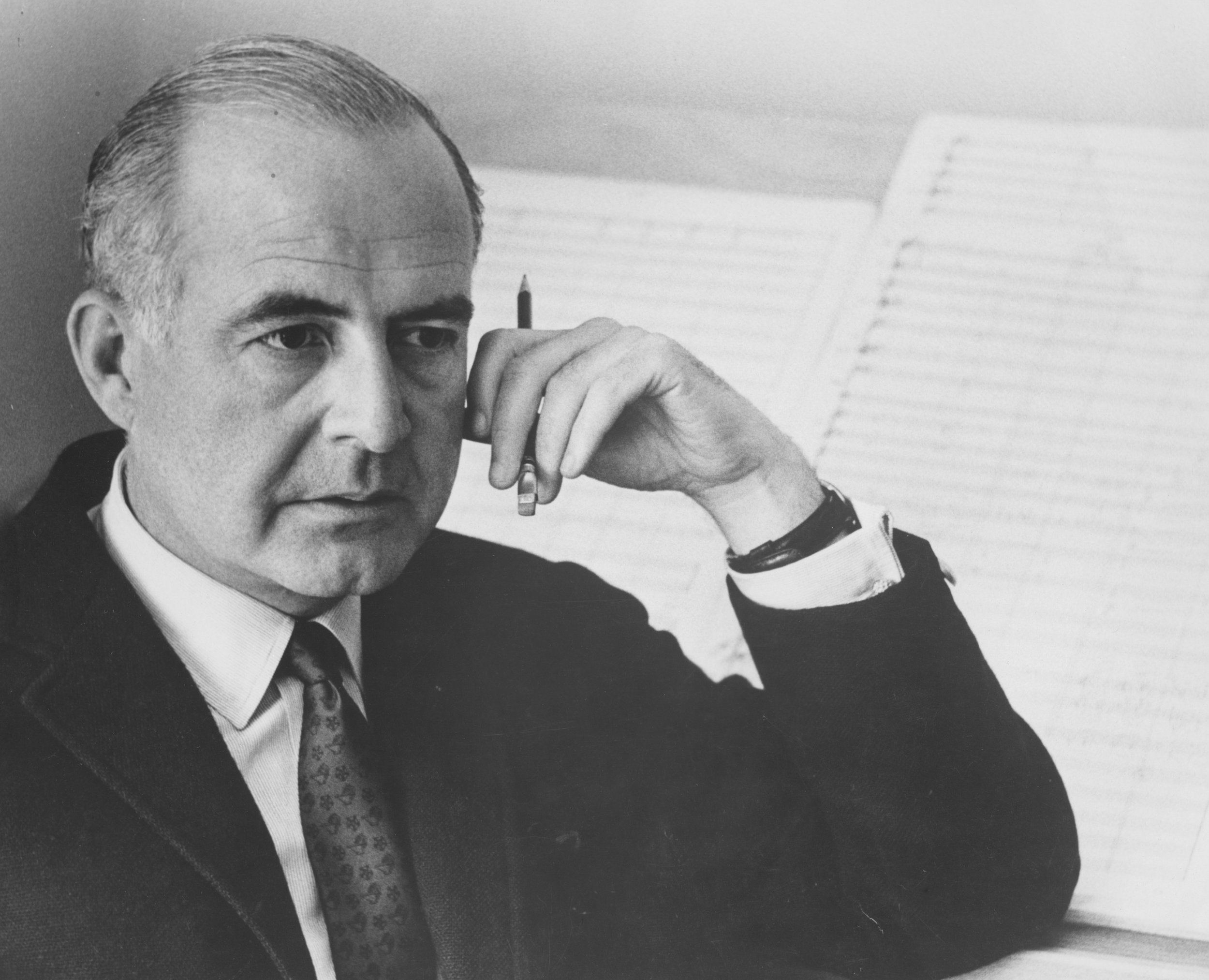
Composer: born March 9, 1910, West Chester, PA; died January 23, 1981, New York City
Work composed: 1939, rev. 1948
World premiere: Eugene Ormandy led the Philadelphia Orchestra, with violinist Albert Spalding, on February 7, 1941. The revised version was first performed by violinist Ruth Posselt, with Serge Koussevitzky leading the Boston Symphony Orchestra, on January 6, 1949.
Instrumentation: solo violin, 2 flutes (one doubling piccolo), 2 oboes, 2 clarinets, 2 bassoons, 2 horns, 2 trumpets, timpani, snare drum, piano, and strings
Estimated duration: 25 minutes
Samuel Barber wrote the Violin Concerto, his first major commission, for Samuel Fels, the inventor of Fels Naptha soap, on behalf Fels’ adopted son, violinist Iso Briselli. Barber began work on the concerto in Switzerland in the summer of 1939, but, due to what he described in a letter as “increasing war anxiety,” Barber left Europe in August and returned home with the final movement still unfinished.
At the end of summer 1939, Barber sent the first two movements to Briselli for comment. Briselli was unimpressed, describing them as “too simple and not brilliant enough for a concerto.” Taking these comments to heart, Barber resolved to write a final movement that would afford “ample opportunity to display the artist’s technical powers.” Briselli found fault with this movement as well, calling it “too lightweight” in comparison with the other movements. In a letter to Fels, Barber wrote, “[I am] sorry not to have given Iso what he had hoped for, but I could not destroy a movement in which I have complete confidence, out of artistic sincerity to myself. So we decided to abandon the project, with no hard feelings on either side.” Barber later approached violinist Albert Spalding, who immediately agreed to premiere the work. Because of all the controversy generated by the third movement, Barber gave the concerto a humorous nickname, the “concerto del sapone,” or a “soap concerto,” a reference both to Fels Naptha and the melodrama of soap operas.
Reviews praised the concerto as “an exceptional popular success” and Barber for writing a concerto “refreshingly free from arbitrary tricks and musical mannerisms … straightforwardness and sincerity are among its most engaging qualities.” The late annotator Michael Steinberg called the opening of the first movement “magical,” and goes on to ask, “Does any other violin concerto begin with such immediacy and with so sweet and elegant a melody?” Few works, certainly few concertos, draw the listener in so quickly, and keep our attention focused so completely. The Andante semplice features a heartbreakingly beautiful oboe solo – classic Barber in its yearning – and the violinist answers it with an impassioned yet surprisingly intimate melody that suggests the violin musing aloud to itself.
The finale, a rondo theme and variations, is particularly impressive. In his program notes for the 1941 premiere, Barber wrote, with characteristic understatement, “The last movement, a perpetual motion, exploits the more brilliant and virtuoso characteristics of the violin.” But as biographer Barbara Heyman points out, “This is one of the few virtually nonstop concerto movements in the violin literature (the solo instrument plays for 110 measures without interruption).”
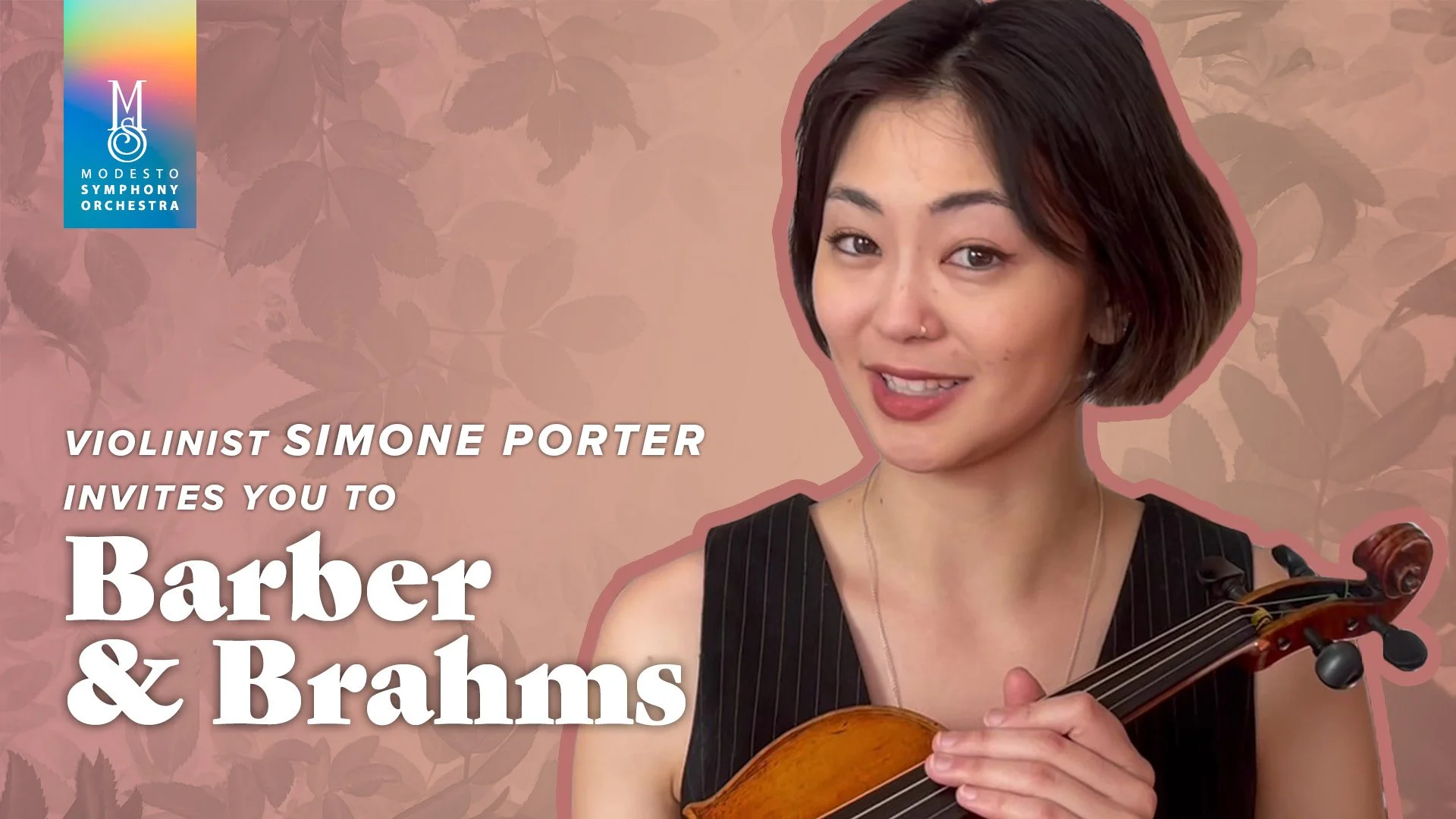
Watch to learn more about Barber’s Violin Concert from violinist Simone Porter!
JOhannes Brahms
Symphony No. 2 in D major, op. 73
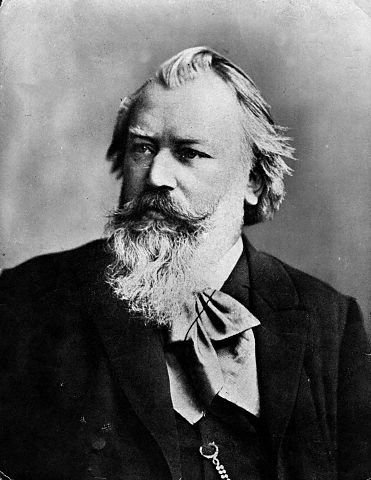
Composer: born May 7, 1833, Hamburg; died April 3, 1897, Vienna
Work composed: During the summer and fall of 1877
World premiere: Hans Richter led the Vienna Philharmonic on December 30, 1877
Instrumentation: 2 flutes, 2 oboes, 2 clarinets, 2 bassoons, 4 horns, 2 trumpets, 3 trombones, tuba, timpani, and strings.
Estimated duration:39 minutes
Less than a year after the successful premiere of Johannes Brahms’ first symphony, on November 4, 1876, the composer left Vienna to spend the summer at the lakeside town of Pörtschach on Lake Wörth, in southern Austria. There, in the beauty and quiet of the countryside, Brahms completed his second symphony. Pörtschach was to be a productive place for Brahms; over the course of three summers there he wrote several important works, including his Violin Concerto. In a letter to critic Eduard Hanslick, a lifelong Brahms supporter, Brahms wrote, “The melodies fly so thick here that you have to be careful not to step on one.”
Unlike Brahms’ first symphony, which took more than 20 years to complete, work on the second went smoothly, and Brahms finished it in just four months. Brahms felt so good about his progress that he joked with his publisher, “The new symphony is so melancholy that you won’t stand it. I have never written anything so sad … the score must appear with a black border.” In a different letter, Brahms self-mockingly observed, “Whether I have a pretty symphony I don’t know; I must ask clever people sometime.”
As Brahms composed, he shared his work-in-progress with lifelong friend Clara Schumann. “Johannes came this evening and played me the first movement of his Second Symphony in D major, which greatly delighted me,” Schumann noted in her diary in October 1877. “I find it in invention more significant than the first movement of the First Symphony … I also heard a part of the last movement and am quite overjoyed with it. With this symphony he will have a more telling success with the public as well than he did with the First, much as musicians are captivated by the latter through its inspiration and wonderful working-out.”
The Symphony No. 2 is often described as the cheerful alter ego to the solemn melancholy of the Symphony No. 1. Brahms uses the lilting notes of the Allegro non troppo as a common link throughout all four movements, where they are repeated, reversed and otherwise, in Schumann’s words, “wonderfully worked-out.” In the extended coda, Brahms introduces the trombones and tuba, casting a tiny shadow over the sunny mood. The Adagio’s lyrical cello melody hints at the wistful melancholy that characterizes so much of Brahms’ music. The Allegretto grazioso is remarkably gentle, and the infectious joy of the closing Allegro con spirito expands on the first movement’s amiable mood, so much so that at the Vienna premiere, the audience demanded an encore.
© Elizabeth Schwartz
NOTE: These program notes are published here by the Modesto Symphony Orchestra for its patrons and other interested readers. Any other use is forbidden without specific permission from the author, who may be contacted at www.classicalmusicprogramnotes.com

Holiday Candlelight Concert
Tuesday, December 20, 2022 at 8 pm
Modesto Symphony Orchestra
Holiday Candlelight Concert
Tuesday, December 20, 2022
Doors Open at 7 pm
Concert Starts at 8 pm
St. Stanislaus Catholic Church
1200 Maze Boulevard, Modesto
Program
Johann Sebastian Bach
Orchestral Suite No. 1 in C Major, BWV 1066
I. Overture
VI. Bourrée I and II
George Frideric Handel arr. Tom Kennedy
Joy to the World
- Audience Hum-Along -
arr. Joel Raney and Arnold Sherman
An Angelic Celebration
- Opus Handbell Ensemble -
H. Dean Wagner
Carillon
- Opus Handbell Ensemble -
arr. Deborah Kavasch
O Come, O Come Emmanuel
John Rutter
The Very Best Time of the Year
George Frideric Handel
Water Music
V. Air
Ottorino Respighi
Ancient Airs and Dances, Suite No. 1
III. Villanella
Lewis Redner arr. Tom Kennedy
O Little Town of Bethlehem
- Audience Hum-Along -
arr. Steven Pilkington
Coventry Carol
arr. Anna Laura Page
Mary, Did You Know?
- Opus Handbell Ensemble -
arr. Nicholas Hanson
Fum, Fum, Fum
- Opus Handbell Ensemble -
arr. Tom Kennedy
Silent Night
- Audience Hum-Along -
Libby Larsen
Beautiful Star
arr. Mark Riese
I Saw Three Ships
Join Mobile MSO!
Text “CANDLELIGHT” to (209) 780-0424
to receive a link to the concert program & text message updates prior to this performance!
By texting to this number, you may receive messages that pertain to the Modesto Symphony Orchestra and its performances. msg&data rates may apply. Reply HELP for help, STOP to cancel.
About this Performance
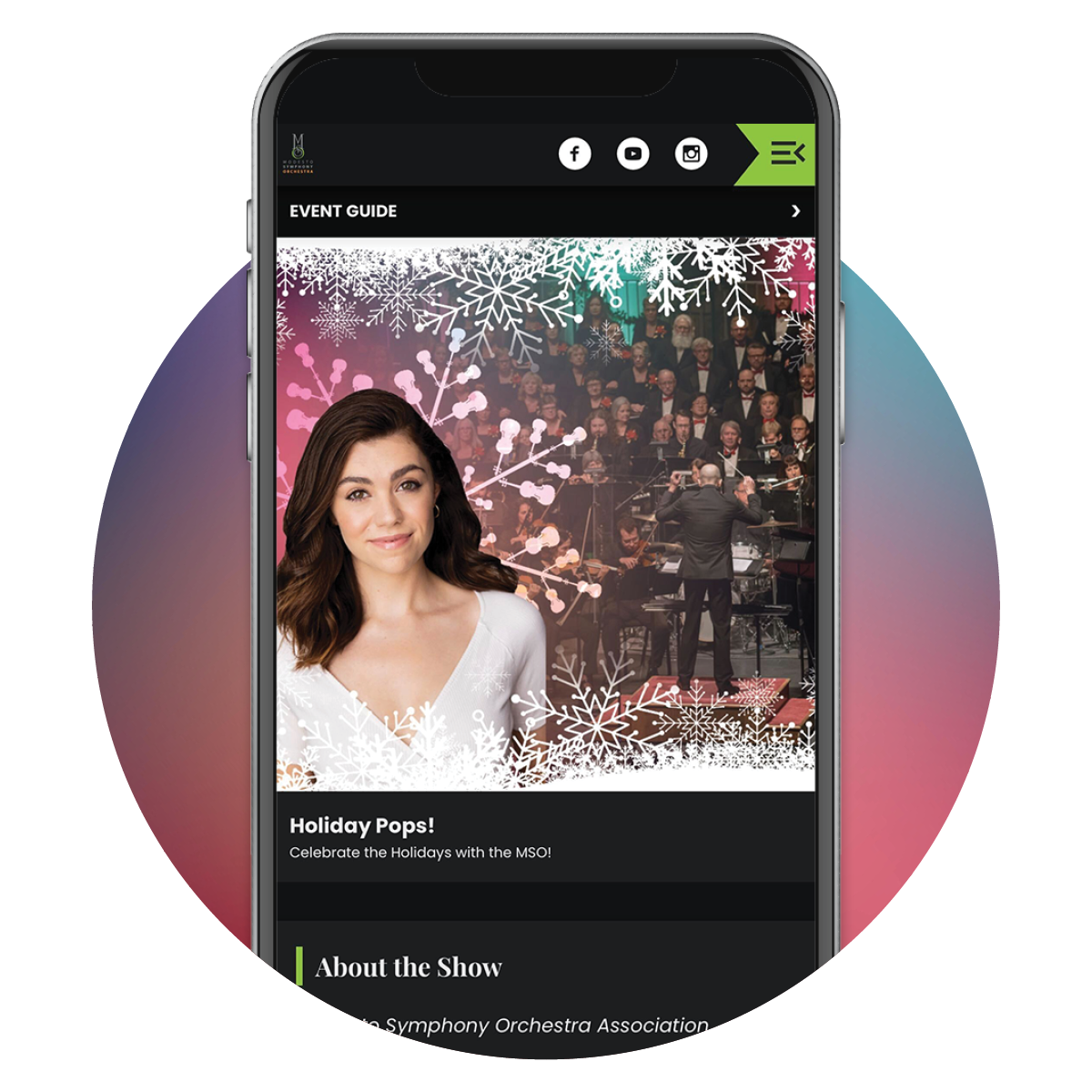
Holiday Pops!
December 2, 2022 at 7:30 pm
December 3, 2022 at 2 pm
VISIT MOBILE PROGRAM →
DOWNLOAD PRINTABLE VERSION →
Modesto Symphony Orchestra
Holiday Pops!
Friday, December 2, 2022 at 7:30 pm
Saturday, December 3, 2022 at 2 pm
Mary Stuart Rogers Theater, Gallo Center for the Arts

Program
Holiday Overture
Elliot Carter / arr. James M. Stephenson, III
Ring the Bells!
Rosephanye Powell
Hark! the Herald Angels Sing
Felix Mendelssohn / arr. Dan Forrest
It’s The Most Wonderful Time of the Year
Edward Pola & George Wyle / arr. Jim Kessler
We Need A Little Christmas
Jerry Herman / arr. by Jim Kessler
Think of Me
Andrew Lloyd Webber & Charles Hart
A Charleston Christmas
arr. James M. Stephenson, III
Christmas Eve/Sarajevo 12/24
Paul O’Neill & Robert Kinkel / arr. by Bob Phillips
All I Want for Christmas is You
Mariah Carey & Walter Afanasieff / arr. Luke Flynn
Intermission -
A Christmas Festival
Leroy Anderson
O Come, O Come, Emmanuel
arr. Taylor Scott Davis
Sleigh Ride
by Leroy Anderson
I Saw Three Ships
arr. James M. Stephenson, III
“Christmas Time is Here” from A Charlie Brown Christmas
Vince Guaraldi / arr. Jim Gray
Jingle Bell Rock
Joseph Beal & James Boothe / arr. Jim M. Stephenson, III
I’ve Got My Love to Keep Me Warm
Irving Berlin / arr. Jim Gray
O Holy Night!
Adolphe Adam / arr. & orc. David T. Clydesdale
Join Mobile MSO!
Text “HOLIDAY” to (209) 780-0424
to receive a link to the concert program & text message updates prior to this weekend’s performance!
By texting to this number, you may receive messages that pertain to the Modesto Symphony Orchestra and its performances. msg&data rates may apply. Reply HELP for help, STOP to cancel.
About this Performance

MSYO Season Opening Concert
November 12, 2022 at 2 pm
Modesto Symphony Youth Orchestra
Season Opening Concert
Saturday, November 12, 2022 at 2 pm
Gallo Center for the Arts, Mary Stuart Rogers Theater

Concert Orchestra
Donald C. Grishaw, conductor
Jean Sibelius (1865-1957), arr. Meyer
Finlandia
Arr. Merle Issac (1898-1996)
Two South American Tango
I. El Choclo
II. La Compasita
Nicolai Rimski-Korsakov (1844-1908) arr. Issac
Fandango and Alborada
Intermission
Symphony Orchestra
Wayland Whitney, conductor
Ralph Vaughn Williams (1872-1958)
March Past of the Kitchen Utensils
Edward German (1862-1936)
Three Dances from Henry VII
I. Morris Dance
II.Torch Dance
Joseph Franz Haydn (1732-1809)
Symphony No. 104, “London”
I. Adagio - Allegro
IV. Finale
Join Mobile MSO!
Text “MSYO” to (209) 780-0424
to receive a link to the concert program & text message updates prior to this performance!
By texting to this number, you may receive messages that pertain to the Modesto Symphony Orchestra and its performances. msg&data rates may apply. Reply HELP for help, STOP to cancel.
About this Performance
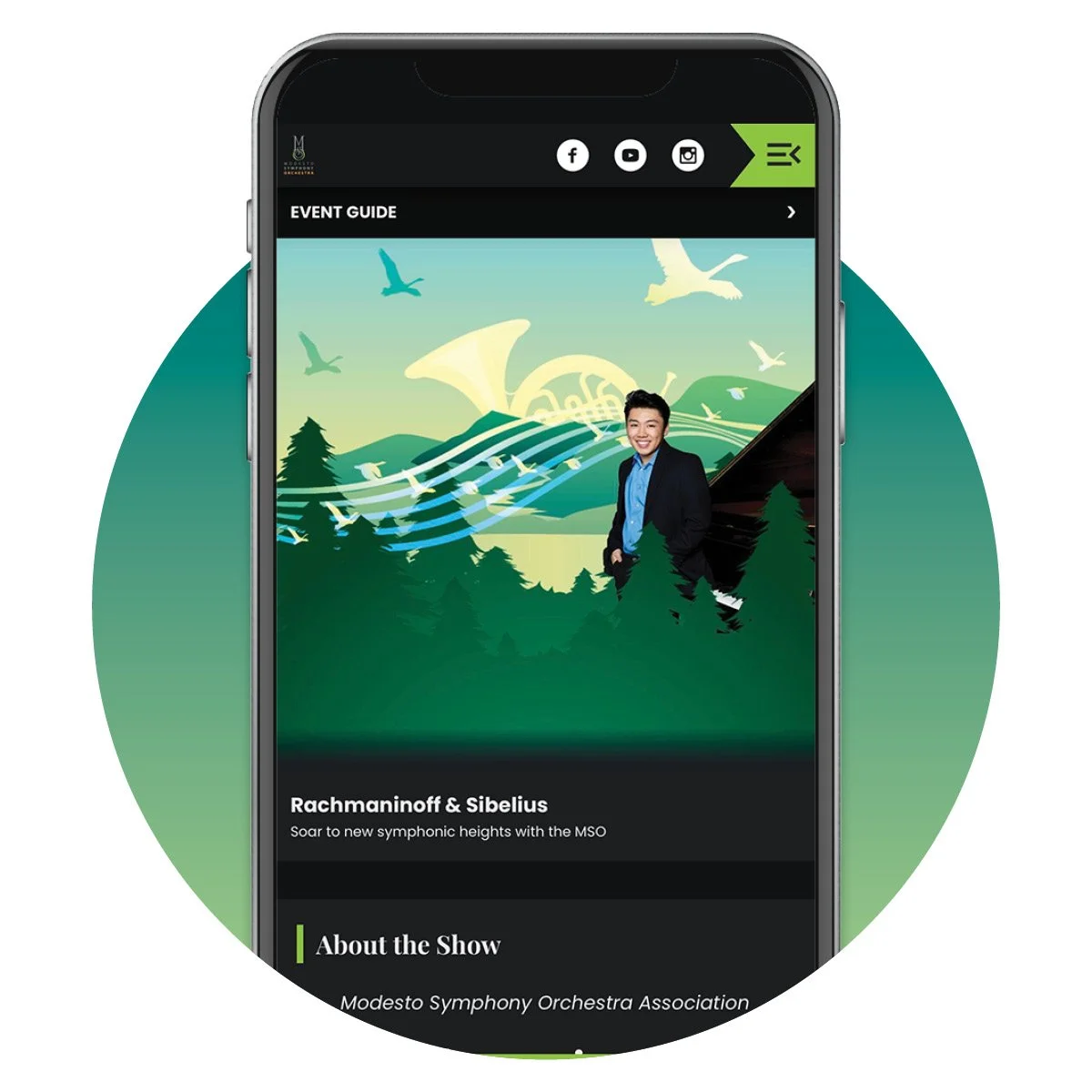
Rachmaninoff & Sibelius
November 11 & 12, 2022 at 7:30 pm
VISIT MOBILE PROGRAM →
READ OUR PROGRAM NOTES →
DOWNLOAD PRINTABLE VERSION (pdf, 3mb) →
Modesto Symphony Orchestra
Rachmaninoff & Sibelius
Friday, November 11, 2022 at 7:30 pm
Saturday, November 12, 2022 at 7:30 pm
Gallo Center for the Arts, Mary Stuart Rogers Theater
Nicholas Hersh, conductor
George Li, piano

Program
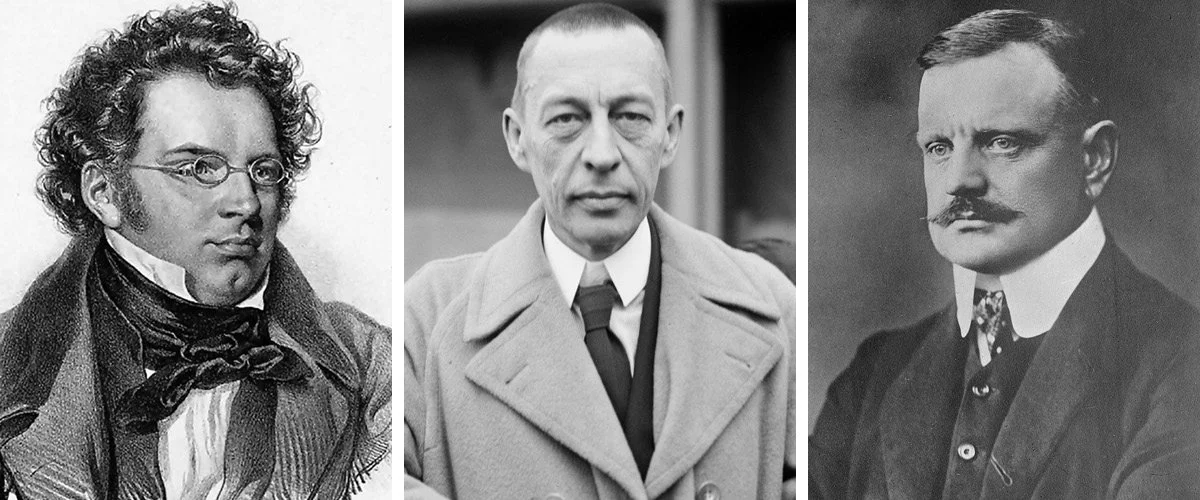
Franz Schubert (1797-1828)
arr. Nicholas Hersh
String Quartet No. 14, II. Andante con moto
Variations on a Theme "Death and the Maiden"
Sergei Rachmaninoff (1873-1943)
Rhapsody on a Theme of Paganini (1934)
George Li, piano
INTERMISSION
Jean Sibelius (1865-1957)
Symphony No. 5 in E-flat major, Op. 95 82 (1915)
i. Tempo molto moderato – Allegro moderato – Presto
ii. Andante mosso, quasi allegretto
iii. Allegro molto – Misterioso – Un pochettino largamente
Join Mobile MSO!
Text “SIBELIUS” to (209) 780-0424
to receive a link to the concert program & text message updates prior to this performance!
By texting to this number, you may receive messages that pertain to the Modesto Symphony Orchestra and its performances. msg&data rates may apply. Reply HELP for help, STOP to cancel.
About this Performance
Enrich Your Concert Experience